English
 Afrikaans
 Albanian
 Amharic
 Arabic
 Armenian
 Azerbaijani
 Basque
 Belarusian
 Bengali
 Bosnian
 Bulgarian
 Catalan
 Cebuano
 Chichewa
 Chinese (Simplified)
 Chinese (Traditional)
 Corsican
 Croatian
 Czech
Czech Danish
 Dutch
Dutch Esperanto
 Estonian
 Filipino
 Finnish
 French
 Frisian
 Galician
 Georgian
 German
 Greek
Greek Gujarati
 Haitian Creole
 Hausa
Hausa Hawaiian
 Hebrew
 Hindi
Hindi Hmong
Hmong Hungarian
 Icelandic
 Igbo
Igbo Indonesian
 Irish
Irish Italian
 Japanese
 Javanese
 Kannada
 Kazakh
 Khmer
Khmer Korean
 Kurdish (Kurmanji)
 Kyrgyz
 Lao
Lao Latin
Latin Latvian
 Lithuanian
 Luxembourgish
 Macedonian
 Malagasy
 Malay
Malay Malayalam
 Maltese
 Maori
Maori Marathi
 Mongolian
 Myanmar (Burmese)
 Nepali
 Norwegian
 Pashto
 Persian
 Polish
 Portuguese
 Punjabi
 Romanian
 Russian
 Samoan
 Scottish Gaelic
 Serbian
 Sesotho
 Shona
Shona Sindhi
 Sinhala
 Slovak
 Slovenian
 Somali
 Spanish
 Sundanese
 Swahili
 Swedish
 Tajik
Tajik Tamil
Tamil Telugu
 Thai
Thai Turkish
 Ukrainian
 Urdu
Urdu Uzbek
Uzbek Vietnamese
 Welsh
Welsh Xhosa
Xhosa Yiddish
 Yoruba
 Zulu
Zulu


Introduction: The Code of Light and the Challenges of Gas Detection
Dangerous gases usually show no color or odor, so people’s natural senses often fail to notice them. For example, minor methane escapes happen in manufacturing plants, harmful fumes move silently through research facilities, and climate-related gases wander freely in the atmosphere; yet, all such unseen hazards share a single trait: every one possesses its distinct spectral pattern.
Each gas particle takes in infrared rays at particular wavelength zones, which in concept allows for touch-free, finely tuned optical spotting. However, everyday reality presents far greater hurdles, since a setup must extract a faint uptake trace amid surrounding clamor, fluctuating heat levels, dampness, and blended airborne substances.
Beijing Bodian Optical Technology Co., Ltd. has zeroed in on this very technical territory over numerous years.

Technical Principle: The Science Behind Spectral Fingerprints and Selective Detection
Uptake of gases in the infrared zone adheres to the Beer-Lambert Law, and since every gas displays its unique uptake ridges, infrared spectroscopy stands as a core approach for spotting them in current practice.
Carbon dioxide features a solid uptake ridge close to 4.26 microns, methane takes in intensely by 3.31 microns, carbon monoxide displays obvious uptake near 4.67 microns, and sulfur dioxide carries its typical zone around 7.3 microns; these steady patterns enable spotting devices to pinpoint gases through gauging light uptake at exact wavelength spots.
Away from lab confines, field situations seldom stay tidy, as heat variations, moisture, ambient substances, and varied blends constantly appear, so the core duty of a spotting device becomes pulling out a small trace tied to a single gas from an ongoing, cluttered range, and frequently, the success of this effort hinges largely on how well the optical filter performs.
Bodian Optical’s Technical Solution: Spectral Windows Tailored for Each Gas
Drawing from long years in thin-film layering know-how, Beijing Bodian Optical has crafted an entire series of infrared filters made just for gas spotting tasks.
This fix’s heart rests in super-slim bandpass filters, where precise handling of layer depth and light-bending index spread lets them let through solely a slim wavelength strip and halt the remainder, thereby forming a sharp optical passage for whatever gas is aimed at.
Key Technical Parameters and Performance Advantages
Bodian Optical filters blend top light passage at peaks with slim range widths, so for aimed wavelengths like 4.26 ± 0.1 microns, the top passage goes beyond 90 percent even as the half-max width holds tight at 0.1 to 0.2 microns, which aids spotting devices in pulling in far sharper traces.
Away from the aimed strip, strong halting ability holds equal weight, with density grades of OD2 to OD3 reached to push down undesired wavelengths to 0.1 percent or below, and this step sharply lowers clashes from the surroundings.
Such filters come designed for rough settings, since methods like ion-boosted layering and magnetron spraying build thick, solidly joined surface layers, and thus from -40°C to 85°C, the light pattern holds firm, fitting them for drawn-out factory work.
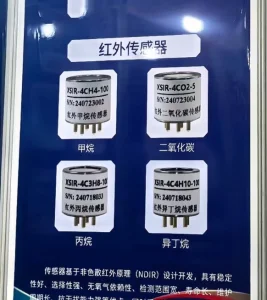
Typical Applications: Customized Solutions for Different Gases
Methane Detection at the 3.31 Micron Band
Within natural gas lines, coal mine guard setups, and waste site gas watches, Bodian Optical’s ILP-3300 series filters fill vital light roles, as their slim 3.31-micron through-strip backs trace sensitivity to ppb scales while firm halting cuts mix-ups from fellow carbon chains floating in the air.
Carbon Dioxide Monitoring at the 4.26 Micron Band
When it comes to following carbon releases, handling processes, and checking air quality inside buildings, the BDF-4260 series filters give solid passage and level through-strip replies at 4.26 microns, plus a woven-in shift-proof layer plan keeps setups steady across lengthy times and lessens calls for regular resets.
Multi-Component Gas Analysis Systems
Spots for environment checks and factory safety gear commonly call for watching several gases side by side, so Bodian Optical’s multi-path filter setups weave in various slim band filters onto one base plate, allowing a lone device to keep tabs on many gases without breaks and trimming back device tangle and upkeep loads.
Technology Evolution: From Single-Point Detection to Imaging Analysis
Classic infrared gas spotting runs from one spot only, but with factory needs swelling, folks now aim to view leak sites, their flow, and live shifts.
Bodian Optical has shaped focused filters linked to chilled mid-wave infrared catchers for optical gas picture devices, which besides catching leaks also lay out their true spots, outlines, and shifts.
Across the petrochemical field, these filters go into OGI cameras letting fix teams picture easy-fleeing carbon mixes leaking right there, and against old sniff ways, check speed jumps past 90 percent to trim safety slips and yield hits.
From Core Components to System Solutions: The Value of Bodian Optical
Bodian Optical offers beyond just filter delivery, as the firm teams up tight with buyers from first device sketch steps to give picks for filter choices, backing for light setups, and checks for output proof.
Conclusion: Technology Sets the Standard, Quality Protects Safety
Amid today’s gas spotting, infrared filters pass beyond plain add pieces, since they set spotting sharpness, feel, and device trust.
Through firm tech bases and steady study spends, Beijing Bodian Optical Technology Co., Ltd. aids in remaking output bars for gas spotting filters.
Be it stopping factory harms, guarding the air cover, running lab breakdowns, or steady web watches, infrared filter methods now fill a main spot in guard and green lasting, so picking Bodian Optical picks a teammate who gets true spotting hurdles and hands custom light fixes.
While guard bars climb and green hurdles swell, Bodian Optical keeps driving infrared filter methods ahead to make unseen harms simpler to catch and handle.
About Beijing Bodian Optical Technology Co., Ltd.
Beijing Bodian Optical Technology Co., Ltd. centers on building and making top-output infrared light filters, with over forty years in thin-film layer work, and its goods see wide work in gas spotting, green watches, factory breakdowns, and guard webs, plus the firm holds ISO 9001 stamp and hands solid light fixes for buyers around the world.
FAQ
Q1: Why are narrow band infrared filters important in gas detection?
A: They let spotting devices pull the true wavelength where a set gas takes light, easing the find of faint gas traces even in loud spots.
Q2: Can Bodian Optical filters be customized for different gases?
A: Yes, filters can get shaped for varied wavelength zones, range widths, and halt grades tied to the aimed gas and device plan.
Q3: Are these filters suitable for long-term outdoor or industrial use?
A: They get made to hold firm over broad heat spans and rough states, fitting them for nonstop factory and green watches.