English
 Afrikaans
 Albanian
 Amharic
 Arabic
 Armenian
 Azerbaijani
 Basque
 Belarusian
 Bengali
 Bosnian
 Bulgarian
 Catalan
 Cebuano
 Chichewa
 Chinese (Simplified)
 Chinese (Traditional)
 Corsican
 Croatian
 Czech
Czech Danish
 Dutch
Dutch Esperanto
 Estonian
 Filipino
 Finnish
 French
 Frisian
 Galician
 Georgian
 German
 Greek
Greek Gujarati
 Haitian Creole
 Hausa
Hausa Hawaiian
 Hebrew
 Hindi
Hindi Hmong
Hmong Hungarian
 Icelandic
 Igbo
Igbo Indonesian
 Irish
Irish Italian
 Japanese
 Javanese
 Kannada
 Kazakh
 Khmer
Khmer Korean
 Kurdish (Kurmanji)
 Kyrgyz
 Lao
Lao Latin
Latin Latvian
 Lithuanian
 Luxembourgish
 Macedonian
 Malagasy
 Malay
Malay Malayalam
 Maltese
 Maori
Maori Marathi
 Mongolian
 Myanmar (Burmese)
 Nepali
 Norwegian
 Pashto
 Persian
 Polish
 Portuguese
 Punjabi
 Romanian
 Russian
 Samoan
 Scottish Gaelic
 Serbian
 Sesotho
 Shona
Shona Sindhi
 Sinhala
 Slovak
 Slovenian
 Somali
 Spanish
 Sundanese
 Swahili
 Swedish
 Tajik
Tajik Tamil
Tamil Telugu
 Thai
Thai Turkish
 Ukrainian
 Urdu
Urdu Uzbek
Uzbek Vietnamese
 Welsh
Welsh Xhosa
Xhosa Yiddish
 Yoruba
 Zulu
Zulu


Performing tasks at elevation presents enough difficulties on its own, yet when the surface under your tires fails to provide support, the assignment becomes considerably more demanding. This situation might involve a wet building area, a loose stone trail, or an inclined garden space, and in such cases, the firmness of your device serves as the key factor separating a productive day from a major incident. At YILU LIFT, a prominent manufacturer located in Qingdao, the emphasis remains consistently on producing equipment that manages these practical, challenging environments with ease and without strain.

Why Is Surface Assessment Critical for Boom Lift Safety?
Prior to considering activation of the elevation control, you must first understand the nature of the foundation beneath you. Many operators cast a quick look at the terrain and deem it adequate, but adequacy does not qualify as a precise measure that maintains a substantial 10-ton unit in balance. Evaluating the surface means examining beyond the visible layer of soil to identify the underlying conditions accurately.
Soil Bearing Capacity Evaluation
Each area of terrain possesses a threshold for the amount of load it can sustain before beginning to yield. If you maneuver a substantial lift and the earth commences compression, the balance point alters immediately. Therefore, you need to confirm that the ground remains sufficiently compacted to withstand the focused force from the wheels or stabilizers. This consideration holds particular importance following precipitation, as what appeared firm soil transforms into a yielding material that may lead the equipment to tilt hazardously.
Identification of Hidden Hazards
The riskiest locations at a work zone are those concealed from view. Such areas include former utility ditches improperly backfilled, obscured access points, or even sizable fragments of concealed timber. Should one wheel sink into a yielding section while the arm extends, the resulting “leverage” amplifies that minor depression into a severe disturbance at the platform’s height. Consequently, conducting an initial walkthrough to probe and detect these potential pitfalls becomes an essential procedure that operators cannot overlook.
Compliance With Gradeability Limits
All boom lifts feature a defined incline tolerance, commonly referred to as gradeability. Attempting to exceed this boundary not only invites the danger of overturning but also imposes considerable strain on the hydraulic drives and braking mechanisms. It proves vital to consult the operator’s guide for those exact ratios, since perceptions like “it appears not so inclined” often precede situations where individuals become immobilized or forfeit command of the unit on an elevation.
How Do Outriggers and Leveling Systems Ensure Stability?
After selecting your position, the subsequent action involves guaranteeing that the equipment maintains evenness, regardless of the terrain’s unevenness. Here, the design elements truly demonstrate their value in preventing mishaps. Effective alignment mechanisms function similarly to the adaptable limbs of a sure-footed animal, conforming to the landscape so that the working area remains entirely horizontal for those inside.
Automatic Leveling Technology
This feature simplifies operations significantly for the user. Consider, for instance, the High End 10m 14m 18m Mobile Towable Boom Lift from YILU LIFT. It incorporates hydraulic stabilizers that manage the adjustment process independently. Rather than relying on trial and error with hand-operated supports, the setup assists in balancing the frame on inclined areas, thereby allowing quicker commencement of tasks. Such innovation saves considerable time and minimizes errors stemming from manual intervention during preparation.
Load Distribution Strategy
Despite employing superior stabilizers, prudent management of weight application to the surface remains necessary. Placing distribution mats or supportive blocking beneath the stabilizer bases qualifies as a standard requirement. By extending the contact area for the load, you substantially reduce the chance of a support embedding into the soil during the operation. This straightforward solution—merely utilizing robust materials—offers substantial reassurance when positioned 15 meters above the ground.
Real-Time Tilt Monitoring
Contemporary units provide ongoing feedback, which benefits safety immensely. They integrate detectors to monitor the equipment’s inclination continuously during use. In the event of terrain movement or adoption of a precarious stance, the device alerts through audible signals or visual indicators. This supervisory function ensures that, should the foundation begin to weaken, sufficient notice allows safe descent of the platform before conditions deteriorate further.
Which YILU LIFT Models Perform Best on Rough Terrain?
Identifying the suitable instrument for the task constitutes a major portion of success. YILU LIFT has dedicated more than 20 years to determining effective field applications and avoiding ineffective ones. Consequently, they have developed various lifts tailored to specific categories of challenging surfaces, preventing the need to adapt ill-suited equipment to mismatched conditions.
High End Towable Cherry Picker
For assignments requiring frequent relocation amid somewhat irregular turf or earth, the 10m-18m Towable Cherry Picker presents a reliable option. It remains lightweight for towing by a conventional vehicle, yet the hydraulic stabilizers previously noted confer the steadiness of a larger apparatus. This serves as an ideal intermediate selection for vegetation maintenance or minor building projects where the location lacks smooth paving but avoids extreme softness.
Heavy Duty Towed Nacelle Basket
To achieve greater elevations—reaching up to 24 meters—the 10-24m Towable Boom Lift proves capable. This version features an enhanced hydraulic arrangement and broader base to accommodate increased altitude. It gains favor for extensive exterior endeavors because its robustness allows sustained positioning on aggregate or firm soil, delivering a dependable area for several personnel along with their equipment.
Crawler Tracked Self-Propelled Lift
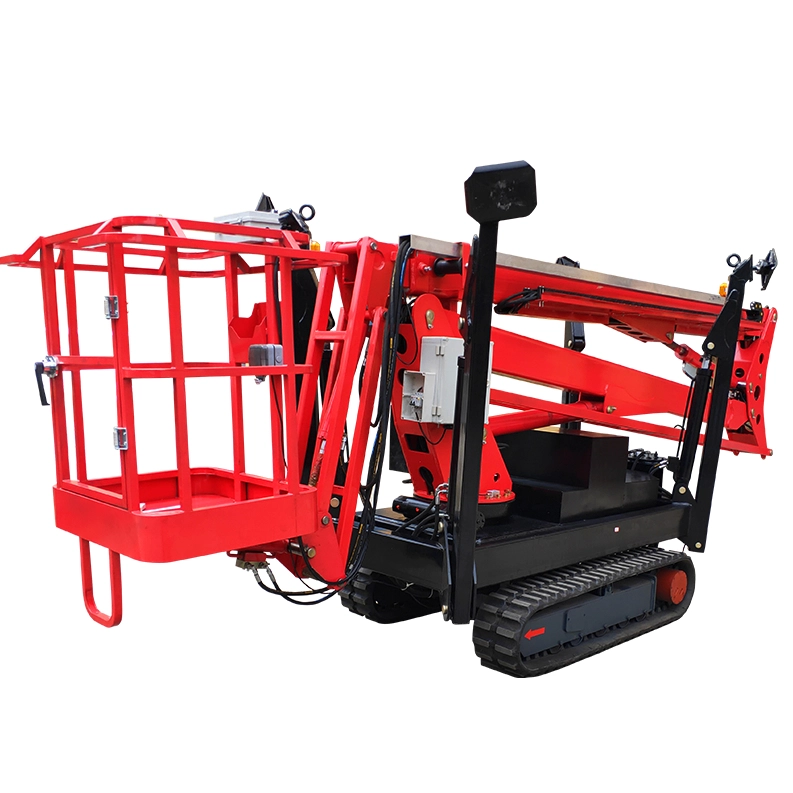
When confronting severely adverse conditions—like deep moisture, unbound granules, or sharp farming inclines—the 10-22m Crawler Boom Lift emerges as the optimal choice. Rather than tires prone to entrapment, this unit employs continuous belts for mobility. These belts distribute mass effectively, enabling the equipment to traverse yielding areas with minimal resistance. It finds preference in farming operations or initial building phases where pathways remain undeveloped.
What Operational Adjustments Should Be Made on Unstable Ground?
Regardless of the superior apparatus, the individual at the controls represents the pivotal element in the safety framework. Managing on irregular terrain demands a deliberate, measured approach. You cannot navigate or pivot the arm as freely as on a level industrial slab; instead, you must modify your technique to align with the surroundings.
Reduced Travel Speed
Velocity often acts as the adversary amid undulating surfaces. Propelling a boom lift rapidly across stones or grooves can induce jolts throughout the structure, potentially damaging fluid conduits or destabilizing the platform. By moderating pace, you permit the damping elements and contact points adequate opportunity to mitigate impacts. Although positioning may require additional moments, this approach surpasses the delays associated with extracting an overturned unit from soft earth.
Strategic Boom Positioning
An essential guideline overlooked by novices involves maintaining the arm at minimal height during transit. With the platform elevated, the apparatus becomes disproportionately weighted above. On uneven ground, this configuration heightens overturn susceptibility. Thus, by securing components low and close during movement, you preserve the balance center appropriately. Extension toward altitude should occur only after securing the position and deploying stabilizers.
Frequent Inspection of Hydraulic Seals
Adverse landscapes exert considerable wear on the equipment’s internal components. The persistent oscillation and angling generate intense demands on the fluid actuators responsible for alignment. Establishing a routine perimeter check every several hours to identify fluid residues near the joints proves advisable. Detecting a minor seepage promptly far exceeds the consequences of a support malfunction midway through an assignment.
How Does YILU Support Long-Term Equipment Reliability?
Ultimately, you seek a collaborator committed to their products. YILU LIFT extends beyond mere production and distribution; they have cultivated a standing over two decades for dependable assistance during demanding periods, ensuring sustained efficiency for clients across global locations.
Global After-Sales Service Purpose
Operating in excess of 130 nations, YILU LIFT recognizes that interruptions equate to financial loss. Their support network facilitates prompt resolution of concerns, irrespective of location in Europe, North America, or elsewhere. They acknowledge these units as specialized implements, and their objective centers on maintaining operational readiness aligned with user schedules.
High Manufacturing Quality Standards
Excellence transcends terminology for them; it underpins operations. Each unit departing the Qingdao facility gets constructed to address the distinct, frequently rigorous, demands of users. They incorporate premium alloys and dependable elements, aware that these lifts will encounter authentic settings rather than controlled displays.
Decades of Industry Expertise
Two decades of involvement cannot be fabricated. From inception, YILU LIFT has iteratively improved configurations drawing from operator insights in practical scenarios. This extended background implies they have addressed most foreseeable challenges, yielding apparatus that endures, performs consistently, and aligns logically with operational requirements.
FAQ
Q1: Can I use a towable boom lift on a slope without outriggers?
A: No, you really should not. Towable lifts get designed for deployment with stabilizers fully extended and wheels elevated from the surface to secure a firm, aligned foundation. Operating solely on wheels during an incline invites overturn risks.
Q2: What should I do if the tilt alarm goes off while I’m in the air?
A: The initial response involves maintaining composure. Proceed gradually to retract the arm and descend the platform to ground level. Upon landing, inspect surface conditions and stabilizer arrangements. Typically, this indicates minor foundation adjustment, necessitating realignment prior to re-elevation.
Q3: How do crawler tracks handle paved surfaces compared to rough ground?
A: Crawler tracks excel in moisture and soil by dispersing loads evenly, yet they may abrade refined stone or yielding bituminous layers. When transitioning a crawler unit onto completed areas, applying resilient pads or wooden sheets to the belts helps safeguard the surface from markings.