English
 Afrikaans
 Albanian
 Amharic
 Arabic
 Armenian
 Azerbaijani
 Basque
 Belarusian
 Bengali
 Bosnian
 Bulgarian
 Catalan
 Cebuano
 Chichewa
 Chinese (Simplified)
 Chinese (Traditional)
 Corsican
 Croatian
 Czech
Czech Danish
 Dutch
Dutch Esperanto
 Estonian
 Filipino
 Finnish
 French
 Frisian
 Galician
 Georgian
 German
 Greek
Greek Gujarati
 Haitian Creole
 Hausa
Hausa Hawaiian
 Hebrew
 Hindi
Hindi Hmong
Hmong Hungarian
 Icelandic
 Igbo
Igbo Indonesian
 Irish
Irish Italian
 Japanese
 Javanese
 Kannada
 Kazakh
 Khmer
Khmer Korean
 Kurdish (Kurmanji)
 Kyrgyz
 Lao
Lao Latin
Latin Latvian
 Lithuanian
 Luxembourgish
 Macedonian
 Malagasy
 Malay
Malay Malayalam
 Maltese
 Maori
Maori Marathi
 Mongolian
 Myanmar (Burmese)
 Nepali
 Norwegian
 Pashto
 Persian
 Polish
 Portuguese
 Punjabi
 Romanian
 Russian
 Samoan
 Scottish Gaelic
 Serbian
 Sesotho
 Shona
Shona Sindhi
 Sinhala
 Slovak
 Slovenian
 Somali
 Spanish
 Sundanese
 Swahili
 Swedish
 Tajik
Tajik Tamil
Tamil Telugu
 Thai
Thai Turkish
 Ukrainian
 Urdu
Urdu Uzbek
Uzbek Vietnamese
 Welsh
Welsh Xhosa
Xhosa Yiddish
 Yoruba
 Zulu
Zulu


Grasping the fundamentals of your aerial work platform marks the line between a straightforward task and a serious overturn risk. When you handle a unit from Qingdao YILU LIFT, you engage with a producer that holds more than 20 years of manufacturing background in the elevation field. Although these devices get constructed for sturdiness and consistency, the rules of gravity continue to govern each extending or jointed arm available.

Why Does Boom Extension Impact Lifting Stability?
The more you advance that boom forward, the greater the effort the equipment must exert to remain anchored. Picture it akin to carrying a weighty shopping sack: it proves simple when your arm stays near your body, but your upper arm senses the pressure the instant you stretch to place it on an elevated ledge. This forms the primary difficulty in designing aerial lifts.
The Principles of Leverage and Center of Gravity
Each lift possesses a “tipping point” at which the mass in the platform begins to drag the foundation from its position. As the boom lengthens, the center of gravity moves distant from the equipment’s core. The engineering group at YILU LIFT concentrates on maintaining this equilibrium close, yet the user must remain aware of the distance they extend relative to the load in the platform.
Impact of Horizontal Reach on Rated Load
Sideward extension typically stands as the chief reducer of lifting capacity. Many individuals focus on the elevation they can attain, but the lateral distance they can cover is where the capacity notably decreases. If you stretch across a rooftop or beyond a barrier, the equipment cannot support the identical mass it would manage in a direct upward motion.
Importance of Adhering to Manufacturer Load Charts
The load chart serves as the key document at your work area. It specifies clearly the “safe zone” for each unit of extension. Even as YILU LIFT units earn recognition for their “Techking Advantage” and superior operation, exceeding the chart’s boundaries invites device malfunction or graver issues.
What Happens to Capacity as the Boom Lengthens?
As that extending arm glides outward, the internal pressure on the metal rises. It concerns not only the mass in the platform; rather, it involves the mass of the boom itself projecting into the open. This explains why the capacity figures diminish as the “reach” figures increase.
Reduced Capacity at Maximum Horizontal Extension
Upon reaching the boundary of your sideward extension, your capacity hits its minimum. For instance, a lift able to transport two individuals directly upward might receive a rating for one person or merely some instruments when the arm extends fully sideways. This represents a compromise that every user needs to anticipate prior to ascending.
Structural Stress Factors in Telescopic Operations
Extending sections get built to endure, but they lack indestructibility. The sliding portions of the boom endure substantial force when fully prolonged. The YILU LIFT facility employs robust materials to ensure these sections avoid excessive bending, but the inherent pressure necessitates capping the capacity at extended lengths.
Higher Capacity Ratings for Vertical Lift Positions
If you position the boom close and direct it upward, you achieve the greatest efficiency in terms of mass. Most devices can bear their peak rated load when the boom holds a steep angle and the extension remains limited. This constitutes the most secure and powerful stance for any aerial platform.
Which YILU LIFT Products Offer the Best Extension Balance?
Selecting the appropriate instrument for the assignment involves evaluating your extension needs before acquiring or leasing. Qingdao YILU LIFT supplies various equipment types to suit diverse site demands, ranging from confined interior areas to challenging exterior building tasks.
High-End Towable Boom Lifts for Versatile Heights
The YILU LIFT High End 10m 14m 18m Mobile Towable Boom Lift serves as an excellent versatile option for servicing teams. It often earns the label “Cherry Picker” due to its ease of relocation. It provides a balanced combination of elevation and extension without forming a bulky, weighty device that damages the turf.
10-24m Towed Nacelle Baskets for Maximum Reach
For substantial assignments, the 10-24m Towable Boom Lift emerges as the preferred selection. This unit gets designed for activities such as arbor tasks or servicing expansive retail building fronts. Since it attains up to 24 meters, it incorporates an advanced hydraulic setup to oversee capacity variations during telescopic movement.
10-22m Crawler Boom Lifts for Rough Terrain Stability
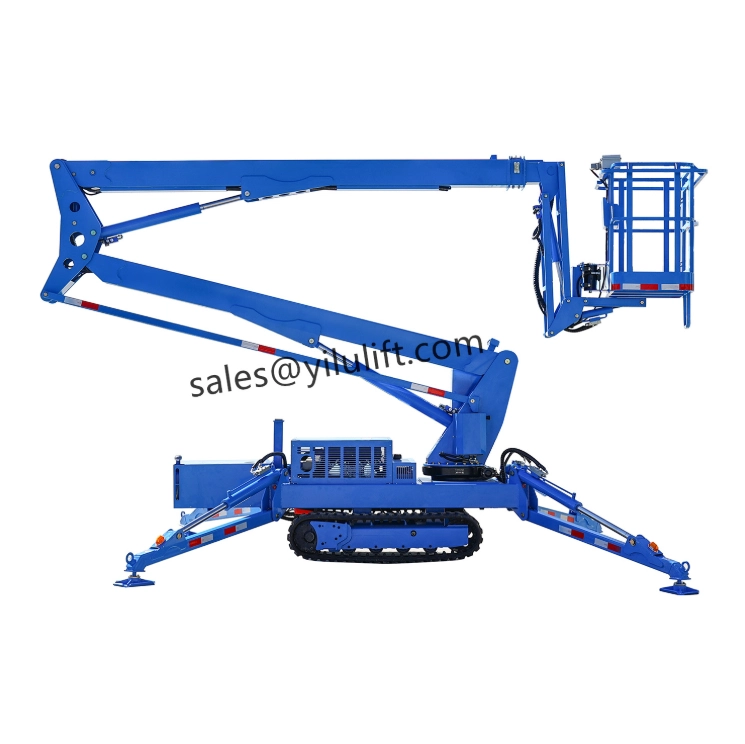
If the surface appears uneven, the 10-22m Crawler Boom Lift becomes the desired choice. As it rests on tracks similar to a military vehicle rather than tires, it features a broader base. This additional firmness on the ground assists the equipment in staying balanced even as you project the boom across a wet building site.
How Does YILU LIFT Ensure Safe Lifting at Full Extension?
Safety extends beyond mere terminology; it defines the essential priority at the YILU LIFT facility. To protect users positioned 20 meters aloft, the devices must perform much of the risk assessment independently. This combines intelligent detectors with traditional robust construction.
Advanced Hydraulic Safety and Overload Protection Systems
Current lifts equip valves and detectors that halt the equipment upon detecting excess mass. If you attempt to extend too distant with a substantial load, the mechanism will engage a “lockout” and prevent further progress into hazardous territory. It functions as a protective measure that secures the equipment’s base firmly.
Durable Material Engineering for High-Quality Machines
YILU LIFT prioritizes utilizing premium metal and parts to confirm the framework of the lift remains solid. A lift’s effectiveness depends on the joints securing it. Through emphasis on endurance and “outstanding performance,” these devices get crafted to withstand the routine demands of an active work site.
Integrated Automation for Real-Time Load Monitoring
Recent versions from the Qingdao facility include enhanced mechanization for overseeing the load. Rather than relying on estimates, the user receives precise indications of remaining capacity. This eliminates uncertainty from the task and allows the team to concentrate on the assignment instead of fretting over potential overturns.
How Can You Choose the Right Boom Lift for Your Needs?
Selecting a lift involves more than identifying the tallest option. You must consider your “working envelope”—the complete zone you can access while adhering to safe capacity boundaries. Misjudging this could result in obtaining a device unable to access the required location.
Assessing Your Specific Maximum Reach Requirements
Prior to examining versions, gauge the span from the equipment’s placement to the remotest point needing access. Avoid focusing solely on upward elevation; sideward distance often imposes the main constraint. If extension of 10 meters proves necessary, verify the equipment’s capacity at that exact length suffices for your instruments and personnel.
Matching Load Weight with Extension Capabilities
Calculate the total mass entering the platform: the user, the instruments, the supplies, and even the weighty protective attire. With that figure determined, compare it to the load chart at the particular extension required. Maintaining a modest “margin” exceeds operating precisely at the boundary.
Consulting YILU LIFT Experts for Customized OEM Solutions
As YILU LIFT operates as a primary factory, they assist with particular requirements that a typical leasing outlet might overlook. Whether involving a dedicated gripping fixture or a tailored elevating platform, their staff endeavors to address the “specific needs of our customers.” Inquiring with the actual constructors always proves beneficial.
FAQ
Q1: Can I bypass the weight sensor if I only need to reach a few inches further?
A: Absolutely not. The safety sensors exist because the equipment approaches its physical boundary. Overriding protective elements can result in the lift overturning or the boom structure breaking.
Q2: Does wind speed affect the lifting capacity at full extension?
A: Yes, wind exerts additional “lateral” pressure on the boom. Most lifts carry a peak wind velocity limit, generally near 12.5 m/s. In strong winds, you must lower the boom, regardless of staying below the mass threshold.
Q3: What is the difference between a telescopic boom and an articulating one for capacity?
A: Telescopic booms, which extend straight, typically provide greater distance and elevated capacities at altitude. Articulating booms, featuring a knuckle joint, suit better for navigating “up and over” barriers but frequently involve more intricate capacity adjustments as the segments shift.