English
 Afrikaans
 Albanian
 Amharic
 Arabic
 Armenian
 Azerbaijani
 Basque
 Belarusian
 Bengali
 Bosnian
 Bulgarian
 Catalan
 Cebuano
 Chichewa
 Chinese (Simplified)
 Chinese (Traditional)
 Corsican
 Croatian
 Czech
Czech Danish
 Dutch
Dutch Esperanto
 Estonian
 Filipino
 Finnish
 French
 Frisian
 Galician
 Georgian
 German
 Greek
Greek Gujarati
 Haitian Creole
 Hausa
Hausa Hawaiian
 Hebrew
 Hindi
Hindi Hmong
Hmong Hungarian
 Icelandic
 Igbo
Igbo Indonesian
 Irish
Irish Italian
 Japanese
 Javanese
 Kannada
 Kazakh
 Khmer
Khmer Korean
 Kurdish (Kurmanji)
 Kyrgyz
 Lao
Lao Latin
Latin Latvian
 Lithuanian
 Luxembourgish
 Macedonian
 Malagasy
 Malay
Malay Malayalam
 Maltese
 Maori
Maori Marathi
 Mongolian
 Myanmar (Burmese)
 Nepali
 Norwegian
 Pashto
 Persian
 Polish
 Portuguese
 Punjabi
 Romanian
 Russian
 Samoan
 Scottish Gaelic
 Serbian
 Sesotho
 Shona
Shona Sindhi
 Sinhala
 Slovak
 Slovenian
 Somali
 Spanish
 Sundanese
 Swahili
 Swedish
 Tajik
Tajik Tamil
Tamil Telugu
 Thai
Thai Turkish
 Ukrainian
 Urdu
Urdu Uzbek
Uzbek Vietnamese
 Welsh
Welsh Xhosa
Xhosa Yiddish
 Yoruba
 Zulu
Zulu


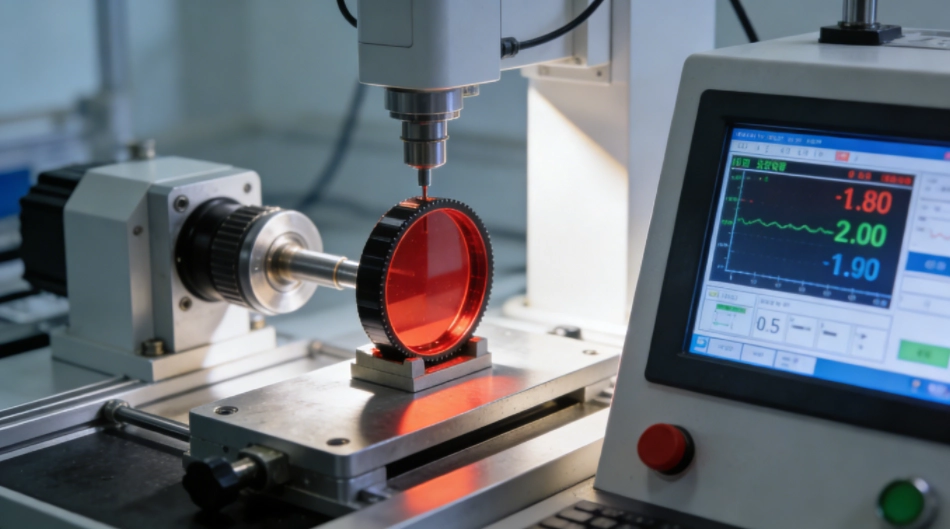
Optical filters act as vital elements in advanced sensing and imaging tasks, but their results rely strongly on the basic setup done prior to applying any coatings. The technique for changing light transmission features starts with a base material that needs careful preparation to manage the detailed methods of vacuum deposition.

Why Is Surface Polishing Essential for Optical Filters?
Setting the surface of an optical part correctly involves more than just cleaning it up; it concerns basic physics principles. Light striking a bumpy surface does not simply go through or bounce back neatly; rather, it spreads out in all directions. This spreading harms effectiveness, particularly in accurate infrared setups where each piece of signal matters a lot. Skilled polishing forms the even “transparent window” needed for electromagnetic waves to pass without extra disruptions.
Reduction of Scattering and Surface Energy Loss
Polishing helps smooth small bumps on the base material’s surface, and this action matters greatly since it sharply lowers light spreading, which then supports a strong signal-to-noise ratio in infrared arrangements. By cutting these energy wastes at the main contact point, the filter keeps the sharpness required for delicate sensing jobs.
Improvement of Thin-Film Coating Adhesion
Once a base material receives polishing to a fine level, it offers a better base for the following dielectric or metal film layers, as these layers require even attachment to the separate base to function well.
Elimination of Structural Edge Defects
Besides the main level areas, the borders of the filter hold equal weight for the full quality of the part. Polishing on both sides counts as a usual need to confirm no damaged borders or splits exist. Experts examine these signs with a microscope, for a small break might weaken the build strength or the look quality of top optical filters.
How Does Polishing Improve Performance in Infrared Long Pass Filters?
The tie between surface readying and results shows clearly in the case of infrared long pass filters, which get made to stop shorter wavelengths yet allow long-wave radiation to go ahead. If the base material misses polishing to a strict measure, then the filter cannot reach the “deep cut” or sharp slope that current infrared sensors call for.
Enhancing Peak Transmittance Above 90%
Joining a nicely smoothed surface with modern coating ways like magnetron sputtering serves as the key to gaining peak transmittance figures past 90 percent, which proves essential for infrared imaging as the sensor must grab as much light as it can to make a sharp picture. Polishing cuts down the uptake and bounce losses that could pull those values lower otherwise.
Ensuring Stability Across the Material Transparent Window
Substances applied in the infrared field, like Silicon, show certain spectral spans where they stay naturally clear, and steady finishing over the base material aids these substances to operate well inside their electromagnetic uptake spans. This setup makes sure the “material transparent window” keeps broad and steady during the filter’s work life.
What Specific Long Pass Solutions Does Bodian Optical Offer?
Bodian Optical has put over 40 years into learning just how to pair base material polishing with fitting coating plans, and the outcome brings a range of infrared long pass (ILP) filters that find use in areas from environmental watching to military guard. These goods get improved by full automatic devices to make certain they fit the hard rules of the field.
ILP3000 for Mid-Infrared Sensing Applications
The ILP3000 stands as a focused long-pass filter that starts at the 3000 nm wave point, and it gets built for mid-infrared sensing, which turns it into a solid pick for factory temperature check tools. With the surface smoothed to a top level, it deals with mid-range infrared heat points using just small waste.
ILP5500 for Gas Detection and Imaging Systems
For setups that must check gases or do thermal picturing, the ILP5500 acts as the main answer, since it blocks shorter waves well while letting the infrared marks of certain gases move to the focal plane sensor. This aid leads to making fine pictures in night drive setups or environmental checkers.
ILP10000 for Far-Infrared and Military Scenarios
The ILP10000 gets shaped for the far-infrared, aiming right at the 8–13 micrometer air window, which marks the best area for military watching and car night sight because it lets infrared radiation move through the air with little uptake. The smoothing here counts as key, since far-infrared waves react keenly to base material traits.
Which Material Substrates Are Best Suited for High-Efficiency Polishing?
Picking the correct base material holds as much weight as the smoothing process, for varied substances show distinct “transparent windows” and body traits that shape their ways under the smoothing tool and in the coating room. From single crystals to hard ceramics, the substance choice sets the surround resistance and light scope of the filter.
Silicon for High Index Needs
Silicon work as main players for high-index infrared wants, yet they bring a drawback: they hold natural high bounce losses, at times from 30 percent to 36 percent before any handling. Skilled smoothing and anti-bounce coatings become required here to turn those big losses into good output. After readying, they give the main support for most top infrared setups.
Zinc Sulfide and Calcium Fluoride for Wide Range Transparency
These substances get smoothed for filters that must span a large spectral area, from ultraviolet clear to far-infrared, and Zinc Sulfide draws special note because it holds clear over a broad strip (0.4-25 μm), turning it into a flexible choice for many-task sensors. They stay strong enough for safety and health uses while keeping steady light work.
Sapphire and Zinc Selenide for Industrial Scenarios
When a filter will face a tough factory setting, Sapphire often picks as the base material choice for its great hardness and surround resistance, and with Zinc Selenide, these smoothed bases can hold steady and keep light work in heats from -50 °C low or 200 °C high. This fit makes them right for outside watching or high-warmth factory sensing.
What Innovative Capabilities Define Bodian Optical in the Industry?
Steadiness in the optical field does not form in a short time, as it needs many years of joining research and putting money into proper tools to make filters that truly match their list details. By holding the whole making flow in one place—from choosing the raw base material to the last spectral check—the evenness of the film layers turns much simpler to handle.
Participation in National Scientific Research Projects
With roots back to 1978, the group has studied advanced materials and optical filters for over 40 years, and this covers giving to more than 20 national scientific research plans, which aided in sharpening the skill knowledge of the full group. This strong base in optics shows they go beyond just building pieces; they tackle hard optical issues.
Utilization of Advanced Imported Coating Equipment
Top smoothing only covers half the path; you need the fitting machines to lay the film, and Bodian draws on brought-in gear like the German Leybold Syrus 1350,Helios 800 and Japanese Optorun coating machines to finish the work. These machines gain note for their exactness in magnetron sputtering and vacuum evaporation, which makes the film layers even and steady each time.
Vertical Integration From Selection to Testing
Handling the full flow stands as the top way to hold costs low and quality high, with all from base material choice to joined making and sharp spectral checking done inside. They use Agilent Cary and PerkinElmer spectrometers to check transmittance, reflectance, and absorbance rightly, making sure each filter stands ready for use.
FAQ
Q1: What is the difference between broadband and narrowband filters in infrared apps?
A: In the world of infrared optics, the distinction usually comes down to the half-bandwidth (HPW). If the half-bandwidth is within 6% of the center wavelength, it’s considered a narrowband filter. If it exceeds that 6% mark, it’s categorized as a broadband filter. Narrowband filters are usually better for picking out very specific signals, while broadband filters are used for more general imaging.
Q2: Why does the price of infrared filters vary so much compared to visible light filters?
A: Infrared filters often use much more expensive substrate materials like Silicon, which require specialized polishing and high-precision coatings to manage their high refractive index. Additionally, the equipment needed to measure and test infrared performance, like high-end spectrometers, adds to the production cost. However, by using local supply chains and large-scale production, companies like Bodian can offer more controllable pricing than many international brands.
Q3: Can these filters handle extreme weather if they are used outdoors?
A: Yes, many infrared filters are specifically designed for environmental tolerance. Some products are built to stay stable in working ranges from -50 °C to 200 °C, making them suitable for everything from desert heat to freezing high-altitude defense applications. Materials like Sapphire are often chosen for these scenarios because they are incredibly rugged and resist scratching and environmental aging.