English
 Afrikaans
 Albanian
 Amharic
 Arabic
 Armenian
 Azerbaijani
 Basque
 Belarusian
 Bengali
 Bosnian
 Bulgarian
 Catalan
 Cebuano
 Chichewa
 Chinese (Simplified)
 Chinese (Traditional)
 Corsican
 Croatian
 Czech
Czech Danish
 Dutch
Dutch Esperanto
 Estonian
 Filipino
 Finnish
 French
 Frisian
 Galician
 Georgian
 German
 Greek
Greek Gujarati
 Haitian Creole
 Hausa
Hausa Hawaiian
 Hebrew
 Hindi
Hindi Hmong
Hmong Hungarian
 Icelandic
 Igbo
Igbo Indonesian
 Irish
Irish Italian
 Japanese
 Javanese
 Kannada
 Kazakh
 Khmer
Khmer Korean
 Kurdish (Kurmanji)
 Kyrgyz
 Lao
Lao Latin
Latin Latvian
 Lithuanian
 Luxembourgish
 Macedonian
 Malagasy
 Malay
Malay Malayalam
 Maltese
 Maori
Maori Marathi
 Mongolian
 Myanmar (Burmese)
 Nepali
 Norwegian
 Pashto
 Persian
 Polish
 Portuguese
 Punjabi
 Romanian
 Russian
 Samoan
 Scottish Gaelic
 Serbian
 Sesotho
 Shona
Shona Sindhi
 Sinhala
 Slovak
 Slovenian
 Somali
 Spanish
 Sundanese
 Swahili
 Swedish
 Tajik
Tajik Tamil
Tamil Telugu
 Thai
Thai Turkish
 Ukrainian
 Urdu
Urdu Uzbek
Uzbek Vietnamese
 Welsh
Welsh Xhosa
Xhosa Yiddish
 Yoruba
 Zulu
Zulu


As smart security, smart homes, and automated interaction systems continue to spread into daily life, human presence detection has quietly become a core link between the physical world and digital decision-making. Among many technical routes, optical infrared-based human sensing stands out thanks to its non-contact nature, stable performance, and low power demand.
What often goes unnoticed, however, is that the real accuracy and long-term reliability of these systems depend heavily on a small but decisive optical component: the infrared optical filter.
This article takes a deep look at how optical human detection works, why infrared filters act as the system’s “optical gatekeeper,” and how well-designed filters can dramatically improve sensing accuracy across real-world environments. The discussion also reflects the practical experience of Bodian Optical, a long-established optical coating specialist serving industrial, medical, and sensing markets.
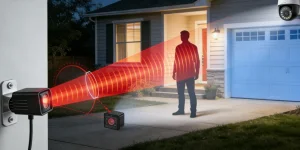
Understanding Optical Human Detection: Capturing the Body’s Thermal Signature
Human detection systems aim to recognize signals that are unique to living bodies. In optical solutions, two physical effects dominate. Each has its own strengths, limits, and filter requirements.
Passive Infrared (PIR): Reading Heat Without Emission
The human body constantly emits infrared radiation as a result of body temperature. Most of this energy lies in the 8–14 µm long-wave infrared (LWIR) range, with a peak near 9.4 µm. PIR sensors track changes in this radiation pattern to detect motion.
These sensors are naturally broadband and sensitive. Without spectral control, they also respond to sunlight, indoor lighting, heating pipes, and even warm air currents. That is where filtering becomes essential.
Active Infrared Sensing: Measuring Reflection and Time
Active systems work in a different way. They emit near-infrared light—commonly 850 nm or 940 nm—and analyze the reflected signal. Techniques such as Time-of-Flight (ToF) and structured light can estimate distance, posture, or subtle movement.
This method delivers more spatial detail but must fight strong background light, especially sunlight, which contains a large near-infrared component.
The Shared Challenge: Environmental Noise
Both passive and active systems face the same enemy: unwanted radiation. Without precise spectral selection, false alarms, missed detections, or unstable behavior become unavoidable.
Infrared Optical Filters: The System’s Spectral Gatekeeper
Infrared filters serve one basic purpose: let the target wavelengths pass, block everything else. How they do this—and how well—defines overall system performance.
Filters in Passive Infrared (PIR) Detection
PIR sensors use elements like pyroelectric detectors or microbolometers, which respond to a wide infrared range. A properly designed filter narrows that response to human body radiation only.
Key functions in PIR systems:
- Pass the 8–14 µm band where human emission is strongest
- Block mid-wave infrared (3–5 µm) from heaters and hot surfaces
- Suppress visible and near-infrared light from sunlight and lamps
Typical high-performance requirements include:
- Average transmission above 90% in the passband
- Blocking depth of OD4–OD6 outside the band
- Steep cut-off edges to reduce overlap
- Stable spectral behavior under angled incidence
In large-scale deployments such as security lighting or industrial motion sensors, these factors directly affect false-trigger rates.
Filters in Active Infrared Systems
Active sensing places most of the filtering burden on the receiver side.
Emitter side:
Narrowband filters may be used to clean up LED or laser output, reducing stray wavelengths.
Receiver side:
A tight bandpass filter matched to the emission wavelength is critical. For example:
- CWL = 850 nm ±2 nm, FWHM ≈ 20 nm
- Deep blocking (OD5 or higher) on both sides of the passband
Sunlight has strong intensity in the near-infrared region, especially above 900 nm. Poor blocking here often leads to outdoor failures, even if indoor tests look fine.

How Filter Performance Shapes System-Level Results
The influence of an infrared filter goes far beyond simple pass or block behavior. Several core system metrics depend directly on filter quality.
Detection Distance and Sensitivity
A small gain in transmission can translate into a noticeable range increase. In practical terms, raising average transmission by just 5% may extend detection distance by 10–15%, depending on system design.
For devices like smart locks or presence sensors, that difference can decide whether detection feels natural or frustrating.
False Alarms and Noise Immunity
Blocking depth matters. In PIR systems, insufficient suppression in the 3–5 µm band can cause heaters or sunlight reflections to trigger false alarms. In active systems, poor rejection near the operating wavelength allows ambient light to overwhelm the sensor.
Industrial-grade systems typically aim for OD4–OD6, while consumer products should still reach OD3 or better.
Environmental Stability
Temperature shifts can move filter cut-off wavelengths. Low-quality coatings may drift by tens of nanometers in cold conditions, letting unwanted light leak in.
Advanced coating processes such as ion-assisted deposition or magnetron sputtering produce dense, stable films with minimal spectral shift from –30 °C to +85 °C.
Long-Term Reliability
Outdoor and industrial environments bring humidity, dust, and UV exposure. Filters designed to standards like ISO 9211-4 or MIL-C-48497 maintain optical performance for years, not months.
Practical Selection Guide: Matching Filters to Detection Methods
Choosing the right filter starts with understanding the sensing principle and environment.
| Detection Type | Recommended Filter | Key Parameters | Typical Examples |
| Passive Infrared (PIR) | 8–14 µm bandpass or long-pass | Tavg >90%, OD4 @ 3–7 µm, low thermal drift | ILP8000, ILP10000 |
| Active IR (850 nm) | 850 nm narrowband | CWL ±2 nm, FWHM ~20 nm, OD5 blocking | BP850-20 |
| Active IR (940 nm) | 940 nm narrowband | CWL ±3 nm, FWHM ~30 nm, OD5 blocking | BP940-30 |
| Multi-spectral systems | Dual-band custom filters | High band isolation, stable substrate | Custom designs |
Additional points to consider:
- Incident angle: wider fields of view need angle-compensated designs
- Sensor matching: filter passband must align with detector sensitivity
- Cost balance: consumer devices may use optical glass, while automotive or industrial systems favor sapphire or silicon substrates
Where the Technology Is Heading
Infrared filters continue to evolve alongside sensing systems.
Multi-Band Integration
Single filters with dual or triple passbands allow systems to switch modes based on lighting or environment, reducing hardware complexity.
Ultra-Narrow and Steep-Edge Designs
Applications like respiration or heart-rate monitoring require isolating extremely weak signals near specific absorption features. This drives demand for sharper edges and deeper blocking.
Micro- and Nano-Structured Filters
Metasurface and nano-patterned filters promise micrometer-scale thickness and on-chip integration, opening new paths for compact sensors.
Why Work With a Specialized Infrared Filter Supplier
Human detection may look simple from the outside, but its optical tolerance is tight. Even a 0.5% spectral leak can raise false alarms by double-digit percentages in outdoor systems.
Experienced manufacturers such as Bodian Optical bring several advantages:
- Application-driven spectral design, not generic curves
- Full in-house control from substrate to coating and testing
- Batch consistency supported by detailed spectral reports
- Environmental testing data for real deployment conditions
- Fast customization for non-standard sizes and wavelengths
With decades of coating experience and advanced evaporation and sputtering equipment, such suppliers help customers shorten development cycles while reducing long-term risk.
Conclusion
Infrared filters may be small, but they define the performance boundary of optical human detection systems. Much like the human iris, they decide which signals reach the system’s “visual nerve” and which are kept out.
In a world moving steadily toward smarter, more responsive environments, choosing the right infrared filter is not just a technical detail. It is a strategic decision that shapes reliability, user trust, and product reputation.
Let the right light in, and machines begin to see the real world more clearly. If you need to match the best filter for your sensing solution, please feel free to contact our team of optical engineers for customized spectral analysis and sample support.
FAQ
Q1: Why can’t a human detection sensor work without an infrared filter?
A: Without filtering, the sensor receives too much unwanted radiation from sunlight, lamps, and heat sources. This overwhelms the useful signal and leads to false alarms or missed detections.
Q2: Is higher transmission always better for infrared filters?
A: High transmission helps, but only within the target band. Poor blocking outside the band can cancel out the benefit by letting noise reach the sensor.
Q3: Can one filter work for both PIR and active infrared systems?
A: In most cases, no. PIR and active systems operate in very different wavelength regions. Multi-band filters exist, but they require careful custom design and system-level validation.