English
 Afrikaans
 Albanian
 Amharic
 Arabic
 Armenian
 Azerbaijani
 Basque
 Belarusian
 Bengali
 Bosnian
 Bulgarian
 Catalan
 Cebuano
 Chichewa
 Chinese (Simplified)
 Chinese (Traditional)
 Corsican
 Croatian
 Czech
Czech Danish
 Dutch
Dutch Esperanto
 Estonian
 Filipino
 Finnish
 French
 Frisian
 Galician
 Georgian
 German
 Greek
Greek Gujarati
 Haitian Creole
 Hausa
Hausa Hawaiian
 Hebrew
 Hindi
Hindi Hmong
Hmong Hungarian
 Icelandic
 Igbo
Igbo Indonesian
 Irish
Irish Italian
 Japanese
 Javanese
 Kannada
 Kazakh
 Khmer
Khmer Korean
 Kurdish (Kurmanji)
 Kyrgyz
 Lao
Lao Latin
Latin Latvian
 Lithuanian
 Luxembourgish
 Macedonian
 Malagasy
 Malay
Malay Malayalam
 Maltese
 Maori
Maori Marathi
 Mongolian
 Myanmar (Burmese)
 Nepali
 Norwegian
 Pashto
 Persian
 Polish
 Portuguese
 Punjabi
 Romanian
 Russian
 Samoan
 Scottish Gaelic
 Serbian
 Sesotho
 Shona
Shona Sindhi
 Sinhala
 Slovak
 Slovenian
 Somali
 Spanish
 Sundanese
 Swahili
 Swedish
 Tajik
Tajik Tamil
Tamil Telugu
 Thai
Thai Turkish
 Ukrainian
 Urdu
Urdu Uzbek
Uzbek Vietnamese
 Welsh
Welsh Xhosa
Xhosa Yiddish
 Yoruba
 Zulu
Zulu


You buy expensive sensors for your factory, but the readings still bounce around. Why does this happen? Most of the time, the sensor itself works fine. The problem is the messy light hitting the detector. Your machine picks up heat from nearby pipes or stray radiation from other equipment. The easiest fix is to put a solid industrial gas analyzer infrared filter in front of the sensor to clean up the incoming signal.
Many hardware buyers waste weeks testing bad optics. They deal with thin films that flake off in humid weather or glass that cracks under heavy vibration. If you want to stop replacing parts constantly, consider BoDian Optical. They do not just sell standard glass blanks. They build precision optics that actually survive harsh conditions. Because they handle the cutting, coating, and testing all inside their own factory, they keep strict quality control. They know exactly how to match specific gas absorption peaks with the right transmission curves.

What Challenges Does an industrial gas analyzer infrared filter Face in the Field?
The factory floor is brutal on sensitive optics. You have to think about what happens to the glass after you bolt it into the machine.
High Background Noise Masks Target Signals
Every working machine gives off heat. This stray light floods your sensor. If your optic component lets this broad noise pass through, the machine cannot tell the difference between the target gas and a hot engine nearby.
Harsh Environments Degrade Optical Components
Factories get hot and damp. When temperatures spike, cheap coatings expand and peel. This shifts the center wavelength. Suddenly, your system misses the target gas peak entirely.
Cross-Sensitivity Causes Inaccurate Gas Readings
Many gases absorb light at very similar points. If your filter bandwidth is too wide, the sensor will pick up overlapping gases and trigger false alarms.
| Target Gas | Common Absorption Peak (µm) | Potential Interfering Element |
| Carbon Dioxide (CO2) | 4.26 | Water Vapor |
| Carbon Monoxide (CO) | 4.64 | Nitrous Oxide |
| Methane (CH4) | 3.30 | Volatile Organic Compounds |
How Does the INBP4260 Isolate Carbon Dioxide Signals?
CO2 detection needs strict boundaries. When you install an industrial gas analyzer infrared filter for this job, you cannot afford light leaks.
Narrow Bandwidth Targets the 4.26 µm Peak
You can use the INBP4260 to fix this problem. It zeroes in exactly on the 4260nm mark. It acts like a strict gate, only opening for the specific CO2 signature and ignoring everything else.
Deep Out-of-Band Blocking Rejects Noise
Blocking depth stops the junk light. This part uses a high Optical Density (OD) rating to push away background radiation. It keeps the signal crisp and stops your monitor from jumping around.
| Optical Density (OD) | Out-of-Band Blocking (%) | Practical Signal Quality |
| OD 2 | 99% | Poor for factory use |
| OD 3 | 99.9% | Standard level |
| OD 4 | 99.99% | High precision |
Durable Coatings Resist Moisture and Heat
The thin film on this component stays put. It handles the damp air and high heat of industrial chimneys without shifting its spectral curve. You get reliable data month after month.
Why Is the INBP4330 Critical for Accurate Gas Sensing?
Sometimes you need to look at specific isotopes or mixed gases that sit just next to standard CO2 lines. Finding a solid industrial gas analyzer infrared filter for this specific peak saves you from massive measurement errors.
Exact Center Wavelength Captures the 4.33 µm Signature
The INBP4330 sits right at the 4330nm line. It handles those subtle shifts in gas detection requirements that standard off-the-shelf parts miss entirely.
High Transmittance Boosts Sensor Sensitivity
Even with a narrow window, you need enough light to actually hit the sensor. This component pushes a massive amount of the target signal through the glass so your detector reacts quickly.
Stable Optical Performance Reduces Recalibration Needs
Once you install this piece, it holds its exact specification for years. Your maintenance crew will not have to open the machine every few weeks to recalibrate the sensor baseline.
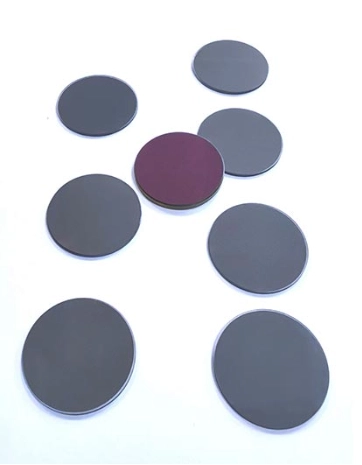
What Makes the INBP10560 Suitable for Specific Industrial Detection?
Long-wave detection requires entirely different materials. Not every factory makes parts that can handle this end of the spectrum.
Specialized Design Focuses on the 10.56 µm Window
The INBP10560 handles specific chemical monitoring. This specific industrial gas analyzer infrared filter pushes a high volume of the 10560nm signal right into your system for fast analysis.
Sharp Transition Edges Boost Measurement Precision
The cut-off lines on this filter are extremely steep. It does not gradually block adjacent wavelengths. It slams the door shut on them, giving you a sharp, clean data feed.
How Can You Get Custom Optical Solutions?
Stop buying generic parts that barely fit your system. You need a supply chain that actually works with your engineering limits.
In-House Manufacturing Speeds Up Your Procurement
Buying direct from the factory cuts out the middleman. The raw material gets cut, coated, and shipped from one location. You get your parts weeks earlier.
Engineering Support Matches Filters to Your Sensors
You do not have to guess which curve works best. Hardware experts review your sensor data sheets and tell you exactly which coating will block your specific noise issues.
Direct Communication Secures Your Next Project Delivery
Talking straight to the production team prevents silly mistakes. You tell them the exact OD value and bandwidth, and they manufacture it exactly to that print.
Contact
Missing the right optical specs ruins your entire gas detection project. We provide custom design suggestions and professional installation guides so you can lock in the exact precision your system needs. These materials are tailored specifically for your current project setup. Tell us your target gas and environment details so we can match the exact industrial gas analyzer infrared filter to your sensor. Feel free to contact our engineering team today.
FAQ
Q What is the lifespan of an industrial gas analyzer infrared filter?
A Quality coatings applied to stable substrates usually last for years, even when exposed to factory heat and humidity. You rarely need to replace them if the initial seal inside the sensor housing holds up well.
Q How does out-of-band blocking affect my detector?
A High out-of-band blocking stops stray light from reaching the sensor. This keeps your data clean and stops false alarms triggered by other heat sources on the factory floor.
Q Can I use the same filter for different target gases?
A No. Every gas has a specific absorption peak. You need a dedicated narrow bandpass component to isolate the exact wavelength of the gas you actually want to measure.