English
 Afrikaans
 Albanian
 Amharic
 Arabic
 Armenian
 Azerbaijani
 Basque
 Belarusian
 Bengali
 Bosnian
 Bulgarian
 Catalan
 Cebuano
 Chichewa
 Chinese (Simplified)
 Chinese (Traditional)
 Corsican
 Croatian
 Czech
Czech Danish
 Dutch
Dutch Esperanto
 Estonian
 Filipino
 Finnish
 French
 Frisian
 Galician
 Georgian
 German
 Greek
Greek Gujarati
 Haitian Creole
 Hausa
Hausa Hawaiian
 Hebrew
 Hindi
Hindi Hmong
Hmong Hungarian
 Icelandic
 Igbo
Igbo Indonesian
 Irish
Irish Italian
 Japanese
 Javanese
 Kannada
 Kazakh
 Khmer
Khmer Korean
 Kurdish (Kurmanji)
 Kyrgyz
 Lao
Lao Latin
Latin Latvian
 Lithuanian
 Luxembourgish
 Macedonian
 Malagasy
 Malay
Malay Malayalam
 Maltese
 Maori
Maori Marathi
 Mongolian
 Myanmar (Burmese)
 Nepali
 Norwegian
 Pashto
 Persian
 Polish
 Portuguese
 Punjabi
 Romanian
 Russian
 Samoan
 Scottish Gaelic
 Serbian
 Sesotho
 Shona
Shona Sindhi
 Sinhala
 Slovak
 Slovenian
 Somali
 Spanish
 Sundanese
 Swahili
 Swedish
 Tajik
Tajik Tamil
Tamil Telugu
 Thai
Thai Turkish
 Ukrainian
 Urdu
Urdu Uzbek
Uzbek Vietnamese
 Welsh
Welsh Xhosa
Xhosa Yiddish
 Yoruba
 Zulu
Zulu


In the tough area of infrared detection, clear signals versus useless clutter often depend on optical filter quality. Systems need parts that extract faint heat patterns from busy settings. This job rests on high performance infrared filters. As factory control and exact health checks grow in 2026, basic ready-made options usually lack enough power. Reaching a sensor’s full potential calls for careful wavelength handling. In this way, each light particle that hits the detector matters for the results.
For a skilled team to tackle these tricky wavelength issues, BoDian Optical leads in the area. Over 40 years in thin-film optical work give them the know-how for key business uses. Their setup uses top German Leybold and Japanese Optorun machines for fine control, like light passage above 90% and blockage at OD6 or more. Beyond making parts, they guide engineering choices to cut wavelength shifts and boost signal-to-noise levels. From new health tools to sturdy gas checkers in factories, their group supplies the steadiness that tech requires.

Why Is Signal Clarity Essential for Maximizing IR Sensor Sensitivity?
An infrared sensor’s sharpness does not stay fixed; it changes based on the background clutter in its setting. When extra light from sun, war machines, or air gases covers the main wavelength, even costly detectors fail to shine. Careful filtering acts as a barrier. It keeps the sensor running at full strength by pulling target signals away from outside disturbances.
Top sharpness often needs a filter built for a certain gas absorption spot or a special heat mark. Off-the-shelf types usually cover too broad a range, letting extra light particles slip in and overload the sensor. Custom builds tighten that range effectively. For instance, the INBP10560 Infrared Narrow Bandpass Filter centers a tight light band at 10,560nm. Such exactness counts in long-wave infrared (LWIR) tasks. There, spotting unique chemical signs demands full wavelength correctness.
Improving SNR in Infrared Detectors Using High Performance Narrowband Filters
The signal-to-noise ratio stands as the main measure for detection setups. High transmittance narrowband filters for thermal imaging systems raise this by blocking wide background clutter. They keep strong peak light flow for the needed signal. With more target light passing through—typically 90% or higher—the detector needs less boost. This cuts electronic clutter naturally and stretches the useful sensing distance.
Enhancing Infrared Detector Performance with Multi-Layer Thin Film Filters
Current thin-film builds stack many layers of dense and light-bending materials. These setups create sharp edges between allowed and blocked zones. Build methods like ion-assisted layering hold these layers firm against damp air or quick heat changes. This firmness stops the main wavelength from moving, so the detector stays matched to its goal over full use.
How Do Spectral Cut-Off Characteristics Influence Thermal Imaging Accuracy?
Sharpness in heat imaging ties to clean splits between infrared ranges. Lacking a crisp cutoff leads to signal overlap. This causes false heat views or wrong readings, mainly in scenes with big light differences. Good wavelength control makes sure the imaging grabs just the right heat energy for solid checks.
Deep Blocking OD3 Infrared Filters for High Performance Thermal Imaging
In spots with strong outside light, like sun rays or bright factory bulbs, extreme blockage levels prove necessary. An OD3 filter stops unwanted light at one part per thousand. For high performance infrared filters, this cutoff sets the mark for 2026 detection rules. It stops stray light from blurring small heat changes in pictures.
| Blocking Depth (Optical Density) | Transmission Ratio | Best Use Case |
| OD2 | 1% (10⁻²) | Standard industrial monitoring |
| OD3 | 0.01% (10⁻3) | Precision 2026 Thermal Sensing |
Role of High Transmittance Infrared Filters in Industrial Gas Detection Systems
Spotting small amounts of gases like methane or carbon dioxide means gathering all possible light from the key mark. Deep blocking OD3 infrared filters for accurate temperature measurement play a part here too, but for gas work, filters such as the ILP3000 Longpass Filter suit well. It lets light over 3,000nm through smoothly. At the same time, it cuts shorter waves sharply. This strong flow keeps portable gas tools correct. They run on low-power sensors and limited light.
Optimizing Full-Spectrum IR Detection with High-Performance Broad-Band Pass Filters
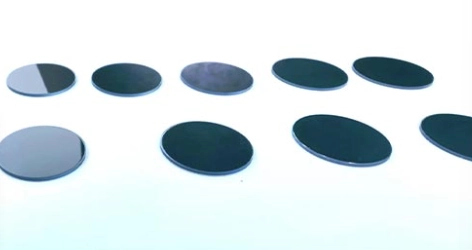
Long-wave and mid-wave thermal detection remains mainstream, while modern integrated detectors demand complete spectral coverage across key atmospheric windows. These require reliable wide-band transmission with strict out-of-band interference rejection. The IWBP3000-5000 broad-band pass filter performs ideally. It delivers steady high transmittance across the entire working infrared range and blocks all unwanted off-band radiation. This ensures full signal integrity and stable output for comprehensive infrared sensing. This ensures full signal integrity and stable output for comprehensive infrared sensing, ideal for factory-wide thermal monitoring and large-area security detection.
What Are the Key Considerations for Selecting Substrates and Coatings?
A filter’s base sets its lasting power and light range. Matching the base and layering method to the job setting ensures steady work over time.
Durable Substrate Selection for Harsh Industrial Environments
In infrared work, base choices stick to strong-bending items like Germanium or Silicon. Each has its clear range and heat traits. Germanium works well for its strong bend, but it blocks light at high heat. Picking the best base weighs light gains against shakes or harsh factory wear.
| Substrate Material | Refractive Index | Typical Window |
| Silicon (Si) | ~3.5 | 1.1 μm – 7 μm |
| Germanium (Ge) | ~4.0 | 1.7 μm – 14 μm |
| Zinc Sulfide (ZnS) | ~2.35 | Visible – 12 μm |
Precision Coating Stability for Long-Term Sensor Deployment
Past heat-based layers often hold open gaps that pull in air moisture, shifting filter work as time passes. In 2026 detection, energetic builds like ion-assisted deposition (IAD) work best. These methods squeeze layers tight, blocking dampness and keeping wavelength work even for years.
Balancing Transmittance and Rejection for Peak System Throughput
Optical plans always involve choices. A tighter range boosts pickiness but cuts total light to the sensor. Partner with an optics specialist to hit the right point. There, light flow stays high for quick replies, and blockage runs deep for strong signal-to-noise. This mix turns a regular sensor into a top detection tool.
Conclusion: Securing Your Precision Sensing Strategy
Building top detector work rests on solid wavelength care. Adding high performance infrared filters to the tech plan equips sensors for today’s challenges. Aiming for OD6 blockage or 90% top light flow, component quality limits system reach. For solid parts and design aid, contact thin-film experts. This step brings infrared projects to full potential.
FAQ
Q: How do high performance infrared filters improve gas detection accuracy?
A: These filters use narrow passbands to isolate the specific “fingerprint” wavelength of a gas while rejecting all other light. This isolation increases the signal-to-noise ratio, allowing the detector to spot even trace amounts of a gas that would otherwise be hidden by environmental noise.
Q: Why is moisture resistance important for infrared coatings?
A: Many infrared materials are naturally porous. If they absorb water from the air, the refractive index changes, causing the filter’s peak wavelength to shift or its transmittance to fall. Advanced energetic coating processes eliminate these pores, ensuring the filter stays calibrated regardless of the humidity.