English
 Afrikaans
 Albanian
 Amharic
 Arabic
 Armenian
 Azerbaijani
 Basque
 Belarusian
 Bengali
 Bosnian
 Bulgarian
 Catalan
 Cebuano
 Chichewa
 Chinese (Simplified)
 Chinese (Traditional)
 Corsican
 Croatian
 Czech
Czech Danish
 Dutch
Dutch Esperanto
 Estonian
 Filipino
 Finnish
 French
 Frisian
 Galician
 Georgian
 German
 Greek
Greek Gujarati
 Haitian Creole
 Hausa
Hausa Hawaiian
 Hebrew
 Hindi
Hindi Hmong
Hmong Hungarian
 Icelandic
 Igbo
Igbo Indonesian
 Irish
Irish Italian
 Japanese
 Javanese
 Kannada
 Kazakh
 Khmer
Khmer Korean
 Kurdish (Kurmanji)
 Kyrgyz
 Lao
Lao Latin
Latin Latvian
 Lithuanian
 Luxembourgish
 Macedonian
 Malagasy
 Malay
Malay Malayalam
 Maltese
 Maori
Maori Marathi
 Mongolian
 Myanmar (Burmese)
 Nepali
 Norwegian
 Pashto
 Persian
 Polish
 Portuguese
 Punjabi
 Romanian
 Russian
 Samoan
 Scottish Gaelic
 Serbian
 Sesotho
 Shona
Shona Sindhi
 Sinhala
 Slovak
 Slovenian
 Somali
 Spanish
 Sundanese
 Swahili
 Swedish
 Tajik
Tajik Tamil
Tamil Telugu
 Thai
Thai Turkish
 Ukrainian
 Urdu
Urdu Uzbek
Uzbek Vietnamese
 Welsh
Welsh Xhosa
Xhosa Yiddish
 Yoruba
 Zulu
Zulu


In today’s watch systems, spotting what eyes cannot see has become a basic need, not an extra feature. Thermal imaging depends a lot on the strength of an Infrared Filter to pull out clear heat patterns from busy surroundings. Be it guarding a key factory area or watching city roads after dark, the sharpness of optical parts sets the steadiness of the whole safety setup.
If seeking a team that understands light challenges well, BoDian Optical emerges as a strong tech leader with more than 40 years of study background. Located in the Beijing Economic Development Zone, the group goes beyond making items; they create new ideas and have joined over 20 country-level science efforts. The team uses top German Leybold and Japanese Optorun tools to build thin-layer fixes that fit strict army and health rules. Partnering with them means adding years of vacuum methods and material knowledge to the setup, not just getting a part.

Why Do Intelligent Systems Need a Multi-band Infrared Detection System for Intelligent Security?
Current safety setups shift from basic night sight to auto-check tools. A multi-band infrared detection system for intelligent security proves vital. It lets one unit spot various signs at the same time, like telling a person from a warm motor.
High-precision Infrared Narrowband Filter for Security to Enhance Signal Clarity
A high-precision infrared narrowband filter for security comes into play when aiming to pick up a narrow signal, such as a laser marker or gas release point. With a pass width under 2% of the main wavelength, such filters cut out sun shine and background clutter. In turn, AI tools get the purest input for spotting heat marks.
Custom Infrared Long Pass Filter for Thermal Imaging to Prevent Signal Interference
Outside settings bring visible rays and close infrared sun heat that can overload heat sensors. A custom infrared long pass filter for thermal imaging serves as a barrier. It lets only heat waves, usually over 3.0μm or 8.0μm, hit the sensor. Safety cameras thus keep working under bright sun or strong man-made lights.
Uncooled Infrared Detector Filter Technology for 24/7 Reliability
Safety gear requires round-the-clock work without the expense and upkeep of cooling fluids. Today’s uncooled infrared detector filter technology applies tough layers on Germanium or Silicon bases. These offer steady results amid big temperature swings. Such steadiness forms the core of city watch networks that last years without hand tweaks.
How Does Superior Wavelength Selection for Thermal Sensors Succeed?
A thermal sensor’s output hinges on its clear range, the exact light band where rays move with little blockage.
Precision Engineering of Infrared Surveillance Camera Optical Filter Solutions
For strong contrast, infrared surveillance camera optical filter solutions hit over 90% passage in the allowed band. At the same time, they hold firm stops, often OD4 or more, in blocked areas. Careful handling of layer depth during vacuum layering makes this possible.
Optimized Spectral Control with High-precision Infrared Narrowband Filter for Security
Tracking certain gas breaks or fire signs calls for exact band matching. Fire watch units, for example, target the 4.26μm CO2 spot. Exact building keeps the filter steady, even in damp or hot factory spots.
Seamless Integration of Uncooled Infrared Detector Filter Technology in Smart Devices
As units get smaller, filters must handle broad entry angles. Since a multi-band infrared detection system for intelligent security pairs with wide lenses, the filter’s working index matters a lot. New layers lessen the color shift from angled light into the lens. This keeps pictures clear across the full view.
| Parameter | Standard IR Filter | High-Precision Security Filter |
| Peak Transmittance | >80% | >90% |
| Blocking Depth | OD2 – OD3 | OD4 or higher |
| Center Wavelength Accuracy | ±2% | ±0.5% or better |
| Environmental Stability | Moderate | MIL-STD Compliant |
Which Specialized Filters Are Essential for Mid-Wave and Long-Wave Applications?
Varied safety cases demand distinct infrared parts. Picking the proper Infrared Filter relies on the warmth level of items to track.
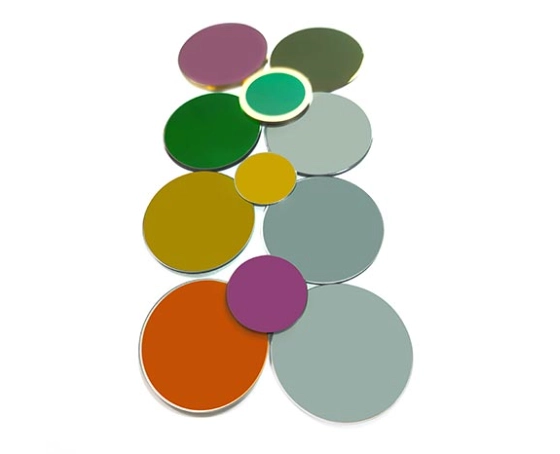
Medium Wave Infrared (MWIR) Solutions with IWBP3000-5000
The IWBP3000-5000 fits the 3-5μm band, a key air-clear path. This filter suits spotting hot items like car fumes or factory machines. Its effective layer lets heat rays through with small loss. Clear, high-detail views aid far-off following.
Long Wave Infrared (LWIR) Detection via IWBP8000-14000
To track body warmth around 9.3μm, the 8-14μm band works best. The IWBP8000-14000 gives the wide pass needed for border watch cameras. This range cuts through haze, dirt, and thin mist, usual blocks in rescue work and army scans.
Narrowband Precision for Gas and Flame Sensing with INBP10560
The INBP10560 picks up CO2 and fire rays. In storage spots or fuel plants, it lets a sensor sound off right when fire begins, well ahead of smoke units. It forms a key part of any multi-band infrared detection system for intelligent security.
| Substrate Material | Refractive Index (n) | Typical Transmittance Range | Typical Use Case |
| Germanium (Ge) | ~4.0 | 2μm – 14μm | LWIR High-end Imaging |
| Silicon (Si) | ~3.4 | 1.2μm – 7μm | MWIR Cost-effective Sensors |
| Zinc Sulfide (ZnS) | ~2.35 | 0.4μm – 12μm | Multi-spectral Systems |
Can Custom Infrared Long Pass Filter for Thermal Imaging Be Tailored to Specific Environments?
Safety tools often meet tough outdoor spots, from sea salt winds to hot sands.
Substrate Selection for Harsh Industrial Conditions
Bases come in several types to fit strength demands. Germanium gives the finest light results for long waves, but Silicon holds up better and costs less for mid-wave uses. Tailored infrared surveillance camera optical filter solutions may add “hard carbon” or Diamond-Like Carbon (DLC) covers to shield the front glass from rough grit or salt mist.
Enhanced Durability with Multi-band Infrared Detection System for Intelligent Security
Steadiness cannot be overlooked. Fresh thin-layer methods, like ion-aided layering (IAD), form covers as dense as solid blocks. This stops dampness from entering levels, which could shift the filter’s output or cause slow changes over time.
Scalable Manufacturing for Global Infrared Surveillance Camera Optical Filter Solutions
From one test piece for study to large runs for worldwide safety goods, evenness counts. Modern plants make sure each lot of uncooled infrared detector filter technology follows the same light path. This way, software rules perform well on every piece placed.
Conclusion: Professional Service and Global Contact Information
Choosing the right Infrared Filter shapes the safety and smooth run of tasks. From high-precision infrared narrowband filter for security in gas checks to custom infrared long pass filter for thermal imaging for dark watches, the best optical piece marks the line between a sharp warning and an overlooked risk.
The aid group brings extra help, like light plan advice and filter picks to ease fitting issues. For study or small lots, they offer quick test turns, often in 1-2 weeks.
For price bids, light data pages, or tech talks, please feel free to contact us. The group stands ready to fine-tune heat sense work with pro-level light tools.
FAQ
Q: What is the primary benefit of using a narrowband Infrared Filter in security?
A: A narrowband filter boosts the signal-to-noise level greatly. It passes just the needed wavelength, like a heat mark or laser, while stopping nearly all other background rays. This leads to sharper input for AI spotting.
Q: Can these filters withstand extreme outdoor temperatures?
A: Yes. Items made with uncooled infrared detector filter technology and power layering steps stay firm from -50°C to 200°C. They avoid the band shifts that usual filters face with heat changes.
Q: Why is Germanium the preferred substrate for LWIR filters?
A: Germanium shows a high bend index near 4.0 and fine clearness in the 8-14μm band. This proves key for catching body heat and viewing past smoke.