English
 Afrikaans
 Albanian
 Amharic
 Arabic
 Armenian
 Azerbaijani
 Basque
 Belarusian
 Bengali
 Bosnian
 Bulgarian
 Catalan
 Cebuano
 Chichewa
 Chinese (Simplified)
 Chinese (Traditional)
 Corsican
 Croatian
 Czech
Czech Danish
 Dutch
Dutch Esperanto
 Estonian
 Filipino
 Finnish
 French
 Frisian
 Galician
 Georgian
 German
 Greek
Greek Gujarati
 Haitian Creole
 Hausa
Hausa Hawaiian
 Hebrew
 Hindi
Hindi Hmong
Hmong Hungarian
 Icelandic
 Igbo
Igbo Indonesian
 Irish
Irish Italian
 Japanese
 Javanese
 Kannada
 Kazakh
 Khmer
Khmer Korean
 Kurdish (Kurmanji)
 Kyrgyz
 Lao
Lao Latin
Latin Latvian
 Lithuanian
 Luxembourgish
 Macedonian
 Malagasy
 Malay
Malay Malayalam
 Maltese
 Maori
Maori Marathi
 Mongolian
 Myanmar (Burmese)
 Nepali
 Norwegian
 Pashto
 Persian
 Polish
 Portuguese
 Punjabi
 Romanian
 Russian
 Samoan
 Scottish Gaelic
 Serbian
 Sesotho
 Shona
Shona Sindhi
 Sinhala
 Slovak
 Slovenian
 Somali
 Spanish
 Sundanese
 Swahili
 Swedish
 Tajik
Tajik Tamil
Tamil Telugu
 Thai
Thai Turkish
 Ukrainian
 Urdu
Urdu Uzbek
Uzbek Vietnamese
 Welsh
Welsh Xhosa
Xhosa Yiddish
 Yoruba
 Zulu
Zulu


Designing an industrial gas detector involves solving complex signal-to-noise ratio issues in harsh environments. The core of this architecture relies on precise thin-film components. BoDian Optical engineers optical components tailored specifically for accurate infrared detection. Choosing filters for an NDIR analyzer directly dictates the reliability, sensitivity, and long-term stability of the final hardware. A poorly matched optical filter passes background noise and overlapping gas signatures, causing false readings that software algorithms cannot fully correct. Engineering the optical path properly requires distinguishing between the specific roles of the measurement and reference channels.
Dual-Channel NDIR Architecture Requirements
Early single-channel detectors struggled heavily with environmental variables and component aging. Modern NDIR gas sensor design mandates a dual-channel setup to mathematically separate the actual gas concentration from systemic hardware errors.
Measurement Channel Gas Absorption
The physical principle of gas detection relies on the Beer-Lambert law. The measurement channel isolates a very specific wavelength where the target gas absorbs infrared energy strongly. For carbon dioxide (CO₂), this is typically the 4.26μm band, while methane (CH₄) requires a 3.3μm center. As the gas concentration inside the sensing chamber increases, the target gas absorbs more light, and the infrared energy reaching the detector decreases proportionally.
Reference Channel Baseline Stability
A single measurement channel cannot distinguish between actual gas absorption and a drop in light intensity caused by external interference. The reference channel provides a continuous baseline signal that remains completely unaffected by the target gas. Implementing this dual-channel approach serves as the primary hardware method to maintain long-term device stability across rigorous industrial environments.
Systemic Drift Cancellation Mechanics
Infrared light sources, such as MEMS micro-bulbs, experience energy degradation over thousands of operating hours. Furthermore, detectors exhibit baseline drift in NDIR instruments due to ambient temperature fluctuations and mechanical stress. By calculating the ratio between the active measurement channel and the stable reference channel, the internal circuitry mathematically cancels out over 90% of these common-mode errors.
Measurement Channel Optical Specifications
Specifying NDIR analyzer filter components requires strict adherence to dielectric interference theory. The deposition parameters dictate the exact shape of the transmission curve, which acts as the physical gatekeeper for the sensor.
Central Wavelength Precision Control
The Central Wavelength (CWL) must align precisely with the target gas’s fundamental absorption peak. Based on thin-film interference mechanics, the CWL tolerance is usually controlled tightly, often within ± 1% of the target wavelength. A slight deviation shifts the spectral peak away from the maximum absorption zone, lowering sensitivity and leading to severe cross-sensitivity in gas detection when overlapping hydrocarbon gases are present in the same test environment.
FWHM and Signal Intensity Balance
The Full Width at Half Maximum (FWHM) dictates the operational passband width. A very narrow FWHM isolates the gas perfectly but severely reduces the total infrared energy reaching the detector, thereby lowering the system’s signal-to-noise ratio. A wide FWHM increases the raw signal strength but risks letting in adjacent wavelengths that are absorbed by interfering ambient gases.
Narrow Bandpass Integration
Achieving the exact FWHM and high peak transmittance simultaneously requires multi-layer dielectric coatings based on Fabry-Perot interference structures. Integrating a high-precision infrared narrow bandpass filter precisely isolates the exact spectral line required, maximizing gas signal capture while reflecting away out-of-band energy to resolve cross-sensitivity in gas detection.
Reference Channel Filter Characteristics
While the measurement side focuses heavily on capturing gas absorption, the reference side is engineered explicitly to avoid any gas interaction.
Selecting a Non-Absorbing Wavelength Band
Developing NDIR reference channels demands the selection of an atmospheric window where common background gases exhibit zero optical absorption. Industry convention typically utilizes the 3.9μm or 4.0μm band for this task. This specific isolation ensures the reference signal remains entirely constant regardless of the gas concentration fluctuating inside the optical cavity.
Matching Transmittance Levels Between Channels
To simplify the backend electronic design and amplification, the infrared filter transmittance of the reference channel should closely match that of the measurement channel. If one filter transmits 85% of incident light and the other only 40%, the resulting raw signal disparity forces engineers to apply different gain factors in the pre-amplifier circuit, which can introduce secondary electrical noise and reduce the accuracy of the final ratio calculation. Consistent infrared filter transmittance across both channels prevents pre-amplifier gain errors.
Optical Path Optimization with Auxiliary Filters
Primary filters for NDIR analyzer designs manage specific gas wavelengths, but system-level optical path optimization requires defending against broader environmental noise and internal reflection losses.
Blocking Short-Wave Interference
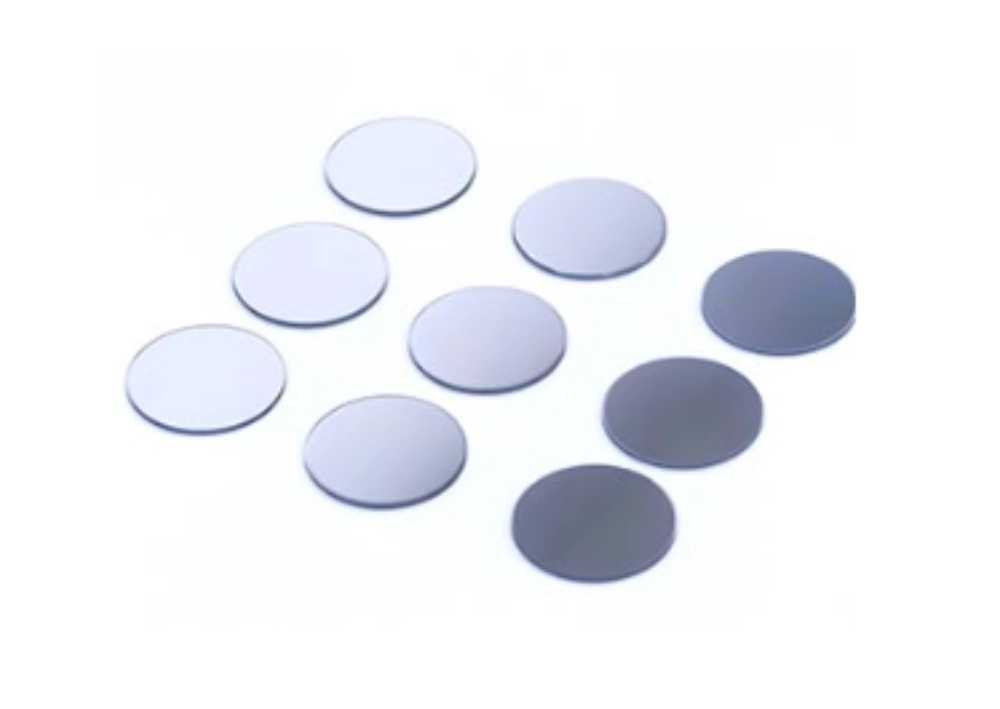
Common infrared detectors, such as pyroelectric sensors and thermopiles, respond to a wide spectrum of thermal radiation, including near-infrared and visible light. Adding an infrared long wave pass filter at the front end of the optical path cuts off these short-wave stray lights. High-end dielectric designs achieve an optical density of OD3 in the blocking zone, meaning out-of-band short-wave transmission is suppressed to below 0.1%.
Maximizing Infrared Energy Transmission
Uncoated infrared substrates like Silicon (with a high refractive index of n ≈ 3.42) reflect approximately 40% of incident light at each air-to-substrate interface. Applying a precisely calculated quarter-wave thick infrared anti-reflection filter coating on sensor windows and focusing lenses drops this surface reflection to less than 1%. This physical modification vastly improves the total energy throughput reaching the active sensing area, marking a critical step in optical path optimization.
Sourcing Reliable Optical Filters for OEM Gas Sensors
Transitioning from a laboratory prototype to industrial mass production demands rigorous evaluation of thin-film durability and the structural stability of the optical substrates.
Verifying Substrate Materials and Coating Durability
Substrates must withstand industrial extremes without deforming. Silicon and Sapphire are widely utilized for their exceptional thermal and mechanical stability in the mid-infrared range. The deposited multi-layer coatings must adhere firmly to these substrates, routinely passing stringent abrasion and humidity tests, such as the MIL-C-675 military standard, ensuring the films do not delaminate during prolonged field operation.
Partnering for Custom NDIR Solutions
Deploying high-performance filters for NDIR analyzer arrays requires tight component integration. We engineer the complete optical stack, ensuring that the narrow bandpass, longpass, and AR coatings function synergistically. Proper thin-film design prevents the introduction of secondary interference fringes that can occur when multiple reflective surfaces are placed in close proximity inside a small sensor housing, ensuring robust NDIR gas sensor design.
Technical Service and Hardware Consultation
Engineers facing strict hardware footprint constraints or struggling to mitigate specific baseline drift in NDIR instruments can rely on tailored coating designs rather than compromising with standard off-the-shelf components. Modifying the FWHM or adjusting the exact center wavelength by a few nanometers often resolves complex interference issues.
A stable NDIR gas sensor design involves rigorous optical matching before the signal ever reaches the processor. If your engineering team is dealing with unexpected drift or struggling to optimize the detection limit of a new gas module, reviewing the exact filters for NDIR analyzer specifications is the necessary next step. We assist hardware developers in analyzing specific transmission curves, selecting durable substrate materials, and finalizing optical layouts. Discuss your wavelength tolerances and mechanical dimensions directly with our engineering team; contact us to align your optical components precisely with your project parameters.
FAQ
What is the standard central wavelength for CO2 measurement filters?
For carbon dioxide detection, filters for NDIR analyzer systems typically utilize a central wavelength of 4.26μm. This specific spectral point aligns directly with the strongest fundamental asymmetric stretching absorption band of the CO₂ molecule, ensuring maximum signal attenuation even at very low gas concentrations.
How does FWHM affect infrared filter transmittance?
A wider Full Width at Half Maximum (FWHM) allows a broader band of light to pass through, which increases the total infrared filter transmittance and the raw analog signal strength hitting the detector. However, if the FWHM is too wide, the passband will overlap with the absorption lines of adjacent gases in the atmosphere, causing false positive readings.
Why can’t I use just one filter for an NDIR gas analyzer?
Using a single filter makes the detection system highly vulnerable to external physical variables. Ambient temperature shifts, micro-dust accumulating on the sensor window, and the gradual dimming of the infrared light source will all cause the detector signal to drop. Without a stable reference channel, the processor will incorrectly calculate this physical signal drop as an increase in target gas concentration. Incorporating dual filters for NDIR analyzer calibration mathematically isolates the gas reading from these hardware fluctuations.