English
 Afrikaans
 Albanian
 Amharic
 Arabic
 Armenian
 Azerbaijani
 Basque
 Belarusian
 Bengali
 Bosnian
 Bulgarian
 Catalan
 Cebuano
 Chichewa
 Chinese (Simplified)
 Chinese (Traditional)
 Corsican
 Croatian
 Czech
Czech Danish
 Dutch
Dutch Esperanto
 Estonian
 Filipino
 Finnish
 French
 Frisian
 Galician
 Georgian
 German
 Greek
Greek Gujarati
 Haitian Creole
 Hausa
Hausa Hawaiian
 Hebrew
 Hindi
Hindi Hmong
Hmong Hungarian
 Icelandic
 Igbo
Igbo Indonesian
 Irish
Irish Italian
 Japanese
 Javanese
 Kannada
 Kazakh
 Khmer
Khmer Korean
 Kurdish (Kurmanji)
 Kyrgyz
 Lao
Lao Latin
Latin Latvian
 Lithuanian
 Luxembourgish
 Macedonian
 Malagasy
 Malay
Malay Malayalam
 Maltese
 Maori
Maori Marathi
 Mongolian
 Myanmar (Burmese)
 Nepali
 Norwegian
 Pashto
 Persian
 Polish
 Portuguese
 Punjabi
 Romanian
 Russian
 Samoan
 Scottish Gaelic
 Serbian
 Sesotho
 Shona
Shona Sindhi
 Sinhala
 Slovak
 Slovenian
 Somali
 Spanish
 Sundanese
 Swahili
 Swedish
 Tajik
Tajik Tamil
Tamil Telugu
 Thai
Thai Turkish
 Ukrainian
 Urdu
Urdu Uzbek
Uzbek Vietnamese
 Welsh
Welsh Xhosa
Xhosa Yiddish
 Yoruba
 Zulu
Zulu


For CEMS and NDIR gas analyzers, select an infrared narrow bandpass filter by matching the target gas absorption band to the source-detector path, then verify FWHM, peak transmission, out-of-band blocking, substrate, angle of incidence, temperature range, and mechanical fit. A filter that looks correct at its nominal center wavelength can still cause cross-sensitivity, weak signal, or baseline drift if the bandwidth, beam angle, blocking, or environmental qualification is mismatched.
BoDian Optical manufactures precision thin-film components for gas analysis and infrared instrumentation. With more than 40 years of optical-coating experience, its production and verification capability includes Helios800 magnetron sputtering, OTFC-1300 coating equipment, and Cary5000/Cary7000 and Spectrum3 spectrometers. For CEMS, filter selection should match the substrate, passband, blocking range, and inspection criteria to the actual analyzer. This supports stable measurement, while regulatory compliance still depends on the complete analyzer, calibration, validation, and maintenance program.
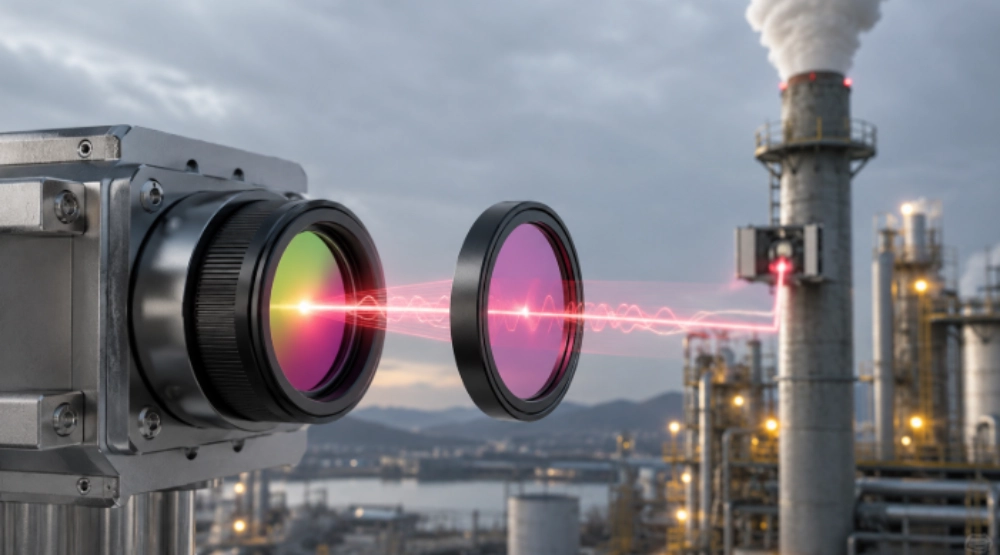
How CEMS Filters Isolate Target Gas Absorption Bands
NDIR accuracy depends on separating the target absorption band before infrared energy reaches the photodetector. The filter specification should therefore be tied to the target gas, source spectrum, optical path, detector response, and reference channel rather than treated as a generic infrared component.
Central Wavelength for CO2, CH4 and Reference Channels
Using the Beer-Lambert relationship, the measurement channel is centered on a molecular absorption feature. A representative CO2 channel is around 4.26 um, while a methane channel is around 3.30 um. Reference channels commonly use an atmospheric window near 3.90 or 4.00 um where the selected background gases have minimal absorption. Because different gases interact with specific infrared bands, infrared absorption by atmospheric gases should also be considered when separating a target absorption feature from nearby background and reference windows. The final CWL must be confirmed against the gas mixture, cell design, detector response, reference strategy, and operating temperature.
FWHM and Cross-Sensitivity Control
The passband must be narrow enough to limit adjacent interference but wide enough to preserve useful detector signal as source output, gas-cell conditions, or temperature vary. For BoDian Optical’s INBP4260 CO2 gas-detection filter, current product data lists a sapphire substrate, CWL 4260 +/- 45 nm, HPB 135 +/- 20 nm, peak transmission T >= 92%, and blocking from 400-11000 nm at T < 1%. These values are specific to that product configuration and should not be treated as universal CEMS limits.
Out-of-Band Blocking and Optical Density
Combustion furnaces and exhaust flues produce broadband thermal radiation that can raise the optical background or saturate thermopile and pyroelectric detectors. For INBP4260, T < 1% across the specified 400-11000 nm blocking range corresponds to at least OD2 over that interval. If deeper suppression is required, specify the OD and wavelength range on the drawing rather than using generic high-blocking language. Also state the measurement angle and production sampling requirement.
How Filter Coatings Affect NDIR Signal Quality
Fresnel Reflection and Anti-Reflection Coatings
Bare high-index substrates reflect a significant fraction of incident light. Silicon, with refractive index near 3.42 in relevant bands, can reflect about 30% at a single air-to-substrate surface under simplified near-normal conditions. In a multi-component NDIR array, these losses reduce signal-to-noise ratio. An anti-reflection coating designed for the actual infrared band can reduce surface reflection to below 1%; the acceptance value should be verified on the coated substrate at the intended wavelength and angle.
Stray Light, Baseline Drift and Detector Saturation
Spectral leakage changes the apparent baseline when the thermal background, source output, or gas concentration changes. A complete optical review should therefore examine the filter curve, source spectrum, detector response, cell windows, and any longpass or shortpass element as one system. Software compensation cannot reliably recover a passband that admits a strong neighboring absorption feature or drives the detector toward saturation.
Environmental Durability Requirements for CEMS
Thermal Cycling and Wavelength Stability
Outdoor analyzers can experience large ambient changes and repeated thermal cycling. Film density and microstructure affect passband stability. Qualify temperature limits for the specific substrate and coating configuration by defining the cycle range, dwell time, number of cycles, reference temperature, and allowable CWL/FWHM drift. Post-cycle spectral results should meet the same acceptance limits used for production release.
Humidity, Corrosive Gas and Coating Adhesion
Humidity and corrosive flue gases can drive delamination, pinholes, or substrate attack. Require adhesion, abrasion, humidity, and chemical-exposure tests that match the analyzer enclosure and service interval. If MIL-C-675 or another durability method is specified, record its scope, revision, exposure conditions, and acceptance criteria rather than using a generic ‘military-grade’ claim.
Selecting Silicon, ZnS or Sapphire
Substrate choice depends on wavelength, transmission, hardness, thermal shock, coefficient of expansion, and machining limits. Silicon is commonly considered for mid-infrared bands and can support bands near 3.90-4.26 um when the complete coating stack is designed for it. Sapphire is mechanically hard and is also used in BoDian Optical’s INBP4260 configuration. Confirm every material against the target band, coating process, mechanical design, and environmental qualification before release.
Custom Filter Design for OEM NDIR Modules
Clear Aperture, Thickness and Optical Path Constraints
Miniaturized multi-gas modules often have limited focal length, aperture, and package space. The RFQ should state clear aperture, outside dimensions, thickness, wedge, chamfer, surface quality, and spatial tolerances. These fields help prevent vignetting, mounting stress, and filter decentering in a divergent beam, so optical and mechanical acceptance should be reviewed together.
AOI Compensation in Divergent Beams
As the beam angle increases away from normal incidence, the effective optical thickness of the dielectric stack decreases and the passband blue-shifts. A custom design should model the AOI distribution in the actual NDIR path and specify whether CWL compensation is applied. Final verification should include the assembled module or a representative optical geometry rather than relying only on a flat coupon measured at normal incidence.
Single-Substrate Multi-Cavity Integration
Stacking separate longpass, shortpass, and narrow bandpass parts adds air gaps, interfaces, and alignment variables. Integrating the required spectral functions on one substrate can reduce internal reflections and simplify mechanical stability when the design allows it. A multi-cavity Fabry-Perot design should be evaluated by its complete transmission curve, flatness across the clear aperture, environmental drift, and production repeatability rather than by center wavelength alone.
Prototype-to-Production Quality Control
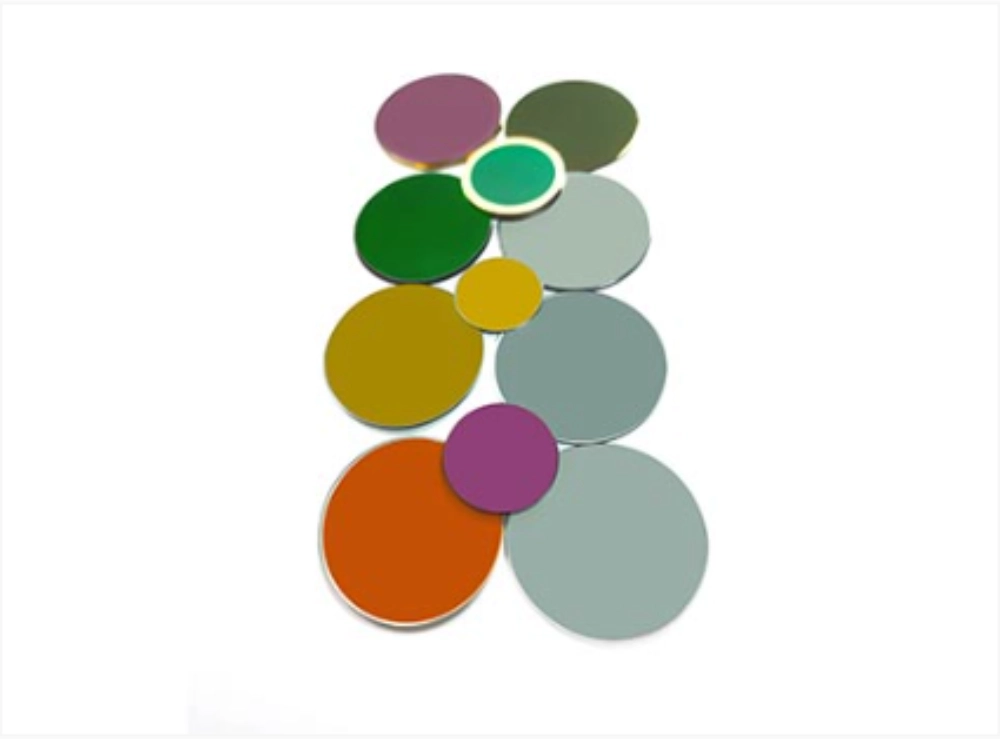
BoDian Optical uses Helios800 magnetron sputtering, OTFC-1300 coating systems, and Cary5000/Cary7000 and Spectrum3 spectrometers. For production approval, request the deposition route, measured spectral plot, dimensional criteria, sampling plan, and lot acceptance limits.
CEMS Filter Procurement Checklist
| Requirement group | Information to provide before quotation |
| Optical | Gas; CWL/FWHM; T; OD; source/detector spectra; AOI |
| Mechanical | Clear aperture; outside diameter or length/width; thickness; wedge; chamfer; mounting method; drawing tolerances |
| Environmental | Operating and storage temperature; humidity; corrosive exposure; thermal cycling; cleaning method; condensate or chemical exposure |
| Commercial and quality | Prototype quantity; annual volume; sample lead time; inspection report; lot acceptance; change-control and traceability needs |
Providing this information lets engineering, quality, and purchasing compare suppliers against the same acceptance criteria and reduces redesign caused by an apparently compatible but optically mismatched off-the-shelf part.
Procurement Next Steps
Before requesting a quotation, contact us with the target gas list, CWL, FWHM, blocking range, detector material, source spectrum, clear aperture, substrate thickness, AOI distribution, operating temperature, humidity exposure, drawing tolerances, prototype quantity, and annual volume. Ask for a measured spectral plot, dimensional drawing, environmental qualification method, sample schedule, and production inspection plan. These inputs help compare prototype performance with production acceptance limits and reduce redesign caused by an optically mismatched part.
FAQ
What is a suitable reference channel wavelength for an NDIR gas sensor?
A reference channel is commonly placed in an atmospheric window near 3.90 or 4.00 um, where the selected background gases have minimal absorption. The correct band still depends on the gas mixture, source, detector, cell windows, reference strategy, and optical temperature, so it should be validated with the measurement channel rather than chosen independently.
How does angle of incidence affect infrared filters for CEMS?
Increasing the beam angle reduces the effective optical thickness of interference layers and shifts the center wavelength and band edges toward shorter wavelengths. Divergent NDIR paths should be modeled and measured across the real angle distribution, especially in compact optical packages.
Why do bare silicon substrates reduce signal-to-noise ratio?
Bare silicon has a high refractive index, so each air-to-substrate surface can introduce substantial Fresnel reflection. An anti-reflection coating can reduce this loss, but its performance should be verified at the actual wavelength, angle, substrate, and coating condition used in the analyzer.