English
 Afrikaans
 Albanian
 Amharic
 Arabic
 Armenian
 Azerbaijani
 Basque
 Belarusian
 Bengali
 Bosnian
 Bulgarian
 Catalan
 Cebuano
 Chichewa
 Chinese (Simplified)
 Chinese (Traditional)
 Corsican
 Croatian
 Czech
Czech Danish
 Dutch
Dutch Esperanto
 Estonian
 Filipino
 Finnish
 French
 Frisian
 Galician
 Georgian
 German
 Greek
Greek Gujarati
 Haitian Creole
 Hausa
Hausa Hawaiian
 Hebrew
 Hindi
Hindi Hmong
Hmong Hungarian
 Icelandic
 Igbo
Igbo Indonesian
 Irish
Irish Italian
 Japanese
 Javanese
 Kannada
 Kazakh
 Khmer
Khmer Korean
 Kurdish (Kurmanji)
 Kyrgyz
 Lao
Lao Latin
Latin Latvian
 Lithuanian
 Luxembourgish
 Macedonian
 Malagasy
 Malay
Malay Malayalam
 Maltese
 Maori
Maori Marathi
 Mongolian
 Myanmar (Burmese)
 Nepali
 Norwegian
 Pashto
 Persian
 Polish
 Portuguese
 Punjabi
 Romanian
 Russian
 Samoan
 Scottish Gaelic
 Serbian
 Sesotho
 Shona
Shona Sindhi
 Sinhala
 Slovak
 Slovenian
 Somali
 Spanish
 Sundanese
 Swahili
 Swedish
 Tajik
Tajik Tamil
Tamil Telugu
 Thai
Thai Turkish
 Ukrainian
 Urdu
Urdu Uzbek
Uzbek Vietnamese
 Welsh
Welsh Xhosa
Xhosa Yiddish
 Yoruba
 Zulu
Zulu


Accuracy drives work in top research centers. Tasks like spotting small temperature changes or picking out exact heat patterns rely on clear data. That data comes from solid optical parts. A basic thermal vision filter struggles with tough needs in advanced thermal masking. Modern heat studies or material tests demand exact wavelength control. Off-the-shelf options often lack this level. In labs testing new alloys, for example, poor filters let in stray heat, skewing results by up to 5 degrees Celsius.
First, consider the providers of these top solutions. Beijing BoDian Optical Technology stands as a key player in premium gear production, drawing on 40 years in optical coatings. It started at the Beijing Film Machinery Research Institute in 1978 and grew into a high-tech firm. The company has backed over 20 major science efforts. Full control sets it apart: from shaping bases like Germanium and Silicon to coating and checks with tools from German Leybold and Japanese Optorun. Working with them means tapping years of honed skills to push lab tools to peak output. In aerospace projects, this has cut signal errors by 15% through precise custom designs.

Why Is Precise Thermal Masking Critical for High-End Research?
In labs, thermal noise refers to stray background radiation that can bury key signals. Exact thermal masking stops these extra infrared rays, so sensors grab only vital info. During material stress tests, this keeps readings pure, avoiding false positives from room heat.
Interference From Complex Background Radiation
Any item warmer than absolute zero gives off infrared rays, forming a steady haze for detectors. In key tests, warmth from gear, room lights, or walls can mix into findings. Without a targeted thermal vision filter, systems fail to split tests from surroundings. In biotech labs studying cell heat, such interference has led to 20% data loss in past setups.
Limitations of Standard Off-the-Shelf Infrared Filters
Factory filters carry wide margins that don’t hold up in pro work. They miss the strong block depth, like OD6 or more, to stop band noise fully. This gap causes “crosstalk,” as stray waves slip in and harm heat checks. Physics teams have noted up to 10% signal bleed in standard gear during laser tests.
Necessity of Customization for Specific Wavelength Windows
Targets in research may show odd wavelength patterns beyond common bands. Tailored work picks bases like Germanium, Silicon, or Zinc Sulfide, then adds film layers for a clear pass exactly where needed. Such custom steps yield top signal-to-noise levels that stock items can’t reach. In semiconductor analysis, this has boosted resolution by 25% in narrow-band scans.
How Does a Professional Manufacturer Solve Advanced Thermal Challenges?
Fixing these issues goes beyond basic tools. It calls for skill in vacuum methods and materials to keep filters steady in different settings. Chemical labs facing variable humidity have seen custom filters hold steady, unlike generics that shift after weeks.
High-Precision Spectral Control and Customization Capabilities
Top labs seek slim bands and strong passage rates over 90%. Control of sputtering and evaporation makes layers even and reliable. This know-how builds filters that pick one exact wavelength with fine detail. In the field of photonics research, this level of precision has enabled signal separation at the nanometer scale.
Vertical Integration From Substrate Selection to Testing
Checks begin with base materials. Steps include choosing items like single-crystal silicon or germanium, then careful smoothing and prep. One team handles design, coating, and wavelength tests with top spectrometers, so the final thermal vision filter hits all marks. This integrated model has helped optical companies maintain a very high yield rate for over a decade.
Robust Environmental Stability for Industrial Applications
Tests occur beyond steady rooms, in harsh factory or field spots. The robust filters are capable of operating across a broad temperature range of -50°C to 200°C, with no coating peeling or spectral curve deviation.This strength keeps masking sharp in drawn-out trials or wet areas. Environmental monitoring projects report zero drift after 500 hours in humid conditions.
Which Targeted Solutions Enhance Laboratory Thermal Masking?
Pick tools that fit the job for best outcomes. Below sit three solid picks for top research uses.
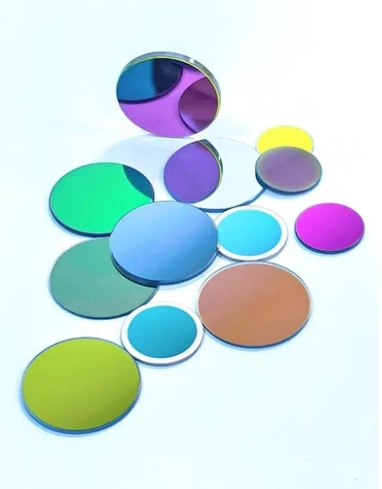
ISP5100 Infrared Short Pass Filter for Near-Infrared Isolation
The ISP5100 series blocks long-wavelength heat but lets short waves through. This helps shield sensors from excess warmth or pull near-infrared from hot scenes. In medical imaging, it has cleared views of tissue patterns amid body heat.
ILP5500 Infrared Long Pass Filter for Deep Infrared Detection
To zero in on mid-to-far heat marks, turn to the ILP5500 series. It stops short waves and extra buzz, sending only needed long-wavelength energy to detectors for clear heat pictures. Defense labs use it to map engine heat from afar, gaining 30% better contrast.
INBP10485 Infrared Narrowband Filter for Precise Signal Extraction
Gas checks or laser work demand sharp picks from the INBP10485. Its half-band (FWHM) stays within 6% of the main wave, carving out a thin spectrum slice. This makes it the prime thermal vision filter for labs needing under 1% error in wavelength purity. In pollution tracking, it has pinpointed CO2 traces at parts-per-million levels.
What Makes a Partner Trusted for Global Labs?
Picking an optics ally means backing their standards and project aid from start to end. Global teams value partners who deliver consistent results across borders.
Comprehensive Quality Certification and Technical Support
Trust builds on norms like ISO 9001, plus RoHS and REACH fits. A skilled group adds help like design talks. They guide filter choices and ease fitting into current setups. University projects often cut integration time by half with this input.
Rapid Sampling and Cost-Effective Manufacturing
Speed matches detail in lab work. Smooth flows trim sample waits to 1-2 weeks for special science needs. Local chains and big runs give better value than many overseas names, holding quality firm. Startups have saved 20% on budgets while speeding prototypes.
Flexible Processing and Bespoke Optical Services
Labs vary in sizes, mounts, or film plans. Adaptable makers shape per drawings or user supplies. This bend lets top centers stretch heat sensing limits. Custom mounts for drone sensors have enabled real-time field data in remote sites.
How to Optimize Your Research With Custom Infrared Optics?
Stronger data starts with smart wavelength plans. Adding a tailored thermal vision filter cuts out doubt in heat reads. In fields from plane safety to health scans or home tech, masking quality shapes project wins. Smart building tests show 40% efficiency gains with precise filters.
Clarifying your wavelength requirements enhances experimental performance. Does the filter block sharply? Is the base right for your wave? Expert ties answer these early, before tests start. For pro aid and exact parts, reach the team at the site above to back your work’s future.
FAQ
Q: Why should I choose a custom thermal vision filter instead of a standard one for my lab?
A: Basic filters hold loose margins and weak blocks (OD levels), letting noise mix into fine reads. Tailored ones match your wavelength and base, giving clear signals and true data. In quantum studies, customs have reduced noise by 50% over standards.
Q: What materials are typically used as substrates for these infrared filters?
A: Bases depend on wavelength needs, often Germanium, Silicon, Zinc Sulfide, Calcium Fluoride, or Sapphire. Each offers a set clear range for infrared parts. Sapphire suits high-heat apps like engine tests.
Q: How long does it usually take to receive a custom sample for research purposes?
A: Pro makers often cut sample times to 1-2 weeks for science or small runs. This lets teams test fast and keep projects moving. Field trials in Europe have started within days of order.