English
 Afrikaans
 Albanian
 Amharic
 Arabic
 Armenian
 Azerbaijani
 Basque
 Belarusian
 Bengali
 Bosnian
 Bulgarian
 Catalan
 Cebuano
 Chichewa
 Chinese (Simplified)
 Chinese (Traditional)
 Corsican
 Croatian
 Czech
Czech Danish
 Dutch
Dutch Esperanto
 Estonian
 Filipino
 Finnish
 French
 Frisian
 Galician
 Georgian
 German
 Greek
Greek Gujarati
 Haitian Creole
 Hausa
Hausa Hawaiian
 Hebrew
 Hindi
Hindi Hmong
Hmong Hungarian
 Icelandic
 Igbo
Igbo Indonesian
 Irish
Irish Italian
 Japanese
 Javanese
 Kannada
 Kazakh
 Khmer
Khmer Korean
 Kurdish (Kurmanji)
 Kyrgyz
 Lao
Lao Latin
Latin Latvian
 Lithuanian
 Luxembourgish
 Macedonian
 Malagasy
 Malay
Malay Malayalam
 Maltese
 Maori
Maori Marathi
 Mongolian
 Myanmar (Burmese)
 Nepali
 Norwegian
 Pashto
 Persian
 Polish
 Portuguese
 Punjabi
 Romanian
 Russian
 Samoan
 Scottish Gaelic
 Serbian
 Sesotho
 Shona
Shona Sindhi
 Sinhala
 Slovak
 Slovenian
 Somali
 Spanish
 Sundanese
 Swahili
 Swedish
 Tajik
Tajik Tamil
Tamil Telugu
 Thai
Thai Turkish
 Ukrainian
 Urdu
Urdu Uzbek
Uzbek Vietnamese
 Welsh
Welsh Xhosa
Xhosa Yiddish
 Yoruba
 Zulu
Zulu


If a diagnostic device gives unstable readings, the problem is not always the reagent, detector, or software. In many optical systems, the filter decides whether the detector receives a clean signal. Thin Film Optical Filters help medical diagnostic equipment select the right wavelength, block unwanted light, and keep fluorescence or IVD readings more consistent across repeated tests.
For buyers searching for thin film optical filters for medical diagnostic equipment, the real concern is whether the filter matches the light source, reagent, detector response curve, optical path, and installation space.
BoDian Optical develops optical thin-film components for medical equipment, imaging systems, fluorescence detection, infrared detection, instruments, and other optical applications. For medical diagnostic projects, its Custom Thin Film Optical Filters, Fluorescence Filters, and Infrared narrow bandpass filter product line can support different optical channels.

Why Do Medical Diagnostic Devices Need Thin Film Optical Filters?
A diagnostic device reads a sample through a controlled optical path, not through broad visual observation. A light source excites or illuminates the sample, filters manage the wavelength range, and the detector converts optical signals into data. If the filter is not matched correctly, the device may read unwanted light as part of the diagnostic signal.
Target Wavelength Selection for Diagnostic Signals
Many diagnostic methods depend on one or several target wavelength bands. In fluorescence readers, PCR-related optical detection, immunoassay systems, and flow cytometry modules, the filter must allow the intended emission band to pass while blocking excitation light and nearby interference.
Background Light Control in Optical Detection
Background light is a common reason optical readings become unstable. A filter with weak blocking may allow stray light or excitation leakage to reach the detector. That can make weak samples harder to separate from noise, especially in low-signal fluorescence testing.
Stable Readings for Clinical and Laboratory Use
For equipment manufacturers, accuracy also means repeatable readings across channels, batches, and operating time. Filter quality, coating consistency, and spectral testing all affect whether an instrument can deliver stable results after integration.
How Do Thin Film Optical Filters Improve Fluorescence Detection?
Fluorescence detection is one of the most demanding medical optical applications. The emitted signal is often much weaker than the excitation light. For buyers comparing thin film optical filters for fluorescence detection, the filter set must separate these signals cleanly, or the detector may receive a mixed optical signal.
Fluorescence Filters for Weak Signal Detection
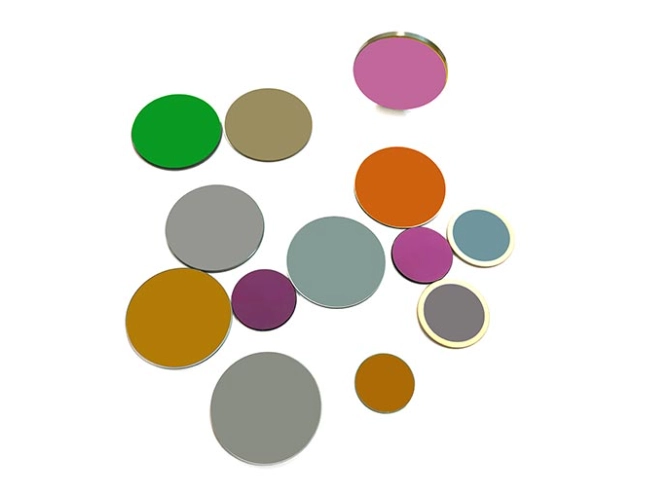
BoDian Optical Fluorescence Filters are suitable for fluorescence analyzers, PCR-related optical detection modules, immunoassay readers, flow cytometry modules, and laboratory diagnostic instruments. They are especially useful where the device must distinguish a weak emission signal from stronger excitation light.
Before selecting Fluorescence Filters, buyers should confirm the excitation wavelength, emission wavelength, detector response, required blocking range, and working angle. A filter that works in one fluorescence channel may not work well in another.
High Blocking Filters for Fluorescence Assays
High blocking thin film filters for fluorescence assays are valuable when the device needs cleaner signal separation and lower optical background. If excitation light leaks into the detector channel, the result may show higher background noise or weaker separation between positive and negative samples.
Blocking depth should not be checked alone. Buyers should also review transmission in the target band, bandwidth, angle sensitivity, and surface quality. A filter with deep blocking but poor useful transmission may still reduce signal strength.
Accurate Fluorescence Measurement Depends on Filter Matching
For thin film optical filters for accurate fluorescence measurement, matching is more important than choosing the most expensive option. The filter must fit the reagent’s emission band, the detector’s response curve, the light source, and the optical layout. In multi-channel fluorescence devices, each channel may need a separate filter design to avoid crosstalk.
Which BoDian Optical Products Fit Medical Diagnostic Equipment?
Medical diagnostic devices are not all built around the same optical method. Some use fluorescence detection. Some use absorbance or colorimetric measurement. Some may include infrared sensing or imaging channels. BoDian Optical products should be selected according to the actual detection principle, not only by product category name.
Custom Filter Design for IVD Device Integration
Custom Thin Film Optical Filters are the main recommendation for IVD equipment manufacturers that need wavelength, size, substrate, or coating design matched to a specific device.
This is why custom thin film filters for IVD devices are often selected during new module development, especially when standard sizes, passbands, or coating structures cannot meet the design. Customization is also useful for compact diagnostic modules, where filter thickness, diameter, coating side, and mounting tolerance may affect assembly.
Fluorescence Filters as the Main Medical Diagnostic Choice
For this article topic, Fluorescence Filters should be the main product recommendation. They directly serve fluorescence signal collection, excitation light blocking, emission channel selection, and multi-channel detection.
A practical buying process should start with the assay type. If the device uses fluorescence markers, the buyer should request filter matching based on excitation and emission bands. If the device uses multiple fluorescence channels, each channel should be checked separately.
Specific IR Channels Need Separate Filter Matching
The Infrared narrow bandpass filter line should be treated as an auxiliary option. It can be relevant when a medical or laboratory device uses infrared sensing, infrared imaging, gas-related optical detection, or a defined IR wavelength channel.
It should not replace Fluorescence Filters in fluorescence-based diagnostic systems. The product is useful only when the device design clearly requires infrared wavelength selection.
What Should Buyers Check Before Choosing Filters for Diagnostic Devices?
Choosing a filter by product name alone is risky. Two filters may look similar but perform differently after integration into the device. The following checks can help reduce selection errors before sampling or batch purchase.
| Buyer Checkpoint | If Ignored, What May Happen | What to Confirm Before Sampling |
| Center Wavelength | Target signal may shift out of the passband | Reagent wavelength, light source, detector curve |
| Bandwidth | More background light may enter the detector | Required FWHM and adjacent channel spacing |
| Blocking Range | Excitation leakage may affect fluorescence readings | OD requirement and unwanted wavelength range |
| Transmittance | Weak signals may become harder to detect | Peak transmission in the useful band |
| Mechanical Size | Filter may not fit the module or holder | Diameter, thickness, tolerance, coating side |
Center Wavelength and Bandwidth Matching
The center wavelength and bandwidth should match the light source, reagent, fluorescence marker, and detector. If the passband is too wide, more interference may enter. If it is too narrow, useful signal may be lost.
High Transmittance and Deep Blocking
High transmittance improves useful signal strength, while deep blocking reduces unwanted light. Buyers should balance both. For weak fluorescence signals, transmission loss can affect sensitivity. For high-background systems, poor blocking can affect result confidence.
Size, Surface Quality, and Batch Consistency
Mechanical fit matters in medical devices. Filter diameter, thickness, edge quality, surface cleanliness, and coating uniformity can affect assembly and optical performance. For repeated production, batch-to-batch spectral consistency should be discussed before purchase.
| Application Need | Recommended BoDian Optical Direction | Suitable When | Not Suitable When |
| Fluorescence signal reading | Fluorescence Filters | The device separates excitation and emission light | The device only uses an infrared sensing channel |
| IVD module customization | Custom Thin Film Optical Filters | Standard wavelength, size, or coating does not fit | The standard filter already matches all optical and mechanical needs |
| Defined IR detection channel | Infrared narrow bandpass filter | The detector needs a specific infrared wavelength | The device is mainly fluorescence-based |
| Multi-channel diagnostic system | Custom filter design | Different channels need different passbands | The device uses only one broad optical channel |
How Can BoDian Optical Support Medical Filter Selection and Custom Projects?
A medical filter project should start with clear technical inputs. Buyers should prepare the target wavelength, passband, blocking range, detector model, light source type, filter size, working angle, and drawing if available. This makes product selection more efficient and reduces the risk of repeated sample changes.
Application-Based Filter Recommendation
BoDian Optical can help buyers connect product categories with actual diagnostic use. For fluorescence diagnosis, Fluorescence Filters are more suitable. For customized IVD systems, Custom Thin Film Optical Filters are more flexible. For infrared detection channels, Infrared narrow bandpass filter products may be considered.
Custom Coating Service for Wavelength and Size Needs
A custom filter may be needed when the device has a non-standard wavelength, compact space, strict blocking requirement, or special coating structure. Custom service is especially useful for new instrument development, small optical modules, and multi-channel diagnostic systems.
Selection Path Before Sampling
For most medical diagnostic equipment, the safest selection path is clear: choose Fluorescence Filters when the system reads excitation and emission signals, choose Custom Thin Film Optical Filters when the device needs a non-standard wavelength or compact mechanical size, and consider an Infrared narrow bandpass filter only when the instrument has a defined IR detection channel. Before ordering samples, buyers should prepare the light source wavelength, detector response curve, required passband, blocking range, filter size, and working angle.
If your diagnostic project involves weak fluorescence signals, multiple detection channels, limited filter space, or an uncertain blocking range, prepare the light source wavelength, detector curve, required passband, and filter size before you contact BoDian Optical. Clear technical inputs help the team judge whether Fluorescence Filters, Custom Thin Film Optical Filters, or an Infrared narrow bandpass filter is more suitable.
FAQ
Q: What Do Thin Film Optical Filters Do in Medical Diagnostic Equipment?
A: Thin Film Optical Filters select useful wavelengths and block unwanted light before the signal reaches the detector. In medical diagnostic equipment, they help improve signal purity, reduce optical noise, and support more stable readings.
Q: Are Fluorescence Filters the Same as Infrared Narrow Bandpass Filters?
A: No. Fluorescence Filters are mainly used to separate excitation and emission light in fluorescence detection. Infrared narrow bandpass filter products are used for defined infrared wavelength selection. The correct choice depends on whether the device reads fluorescence emission, absorbance, or a defined infrared channel.
Q: When Should I Choose Custom Thin Film Optical Filters Instead of Standard Filters?
A: Custom filters are better when a standard product cannot match your wavelength, bandwidth, blocking range, size, or assembly requirements. For IVD devices and fluorescence modules, custom design is often useful when the filter must match a specific reagent, light source, and detector combination.