English
 Afrikaans
 Albanian
 Amharic
 Arabic
 Armenian
 Azerbaijani
 Basque
 Belarusian
 Bengali
 Bosnian
 Bulgarian
 Catalan
 Cebuano
 Chichewa
 Chinese (Simplified)
 Chinese (Traditional)
 Corsican
 Croatian
 Czech
Czech Danish
 Dutch
Dutch Esperanto
 Estonian
 Filipino
 Finnish
 French
 Frisian
 Galician
 Georgian
 German
 Greek
Greek Gujarati
 Haitian Creole
 Hausa
Hausa Hawaiian
 Hebrew
 Hindi
Hindi Hmong
Hmong Hungarian
 Icelandic
 Igbo
Igbo Indonesian
 Irish
Irish Italian
 Japanese
 Javanese
 Kannada
 Kazakh
 Khmer
Khmer Korean
 Kurdish (Kurmanji)
 Kyrgyz
 Lao
Lao Latin
Latin Latvian
 Lithuanian
 Luxembourgish
 Macedonian
 Malagasy
 Malay
Malay Malayalam
 Maltese
 Maori
Maori Marathi
 Mongolian
 Myanmar (Burmese)
 Nepali
 Norwegian
 Pashto
 Persian
 Polish
 Portuguese
 Punjabi
 Romanian
 Russian
 Samoan
 Scottish Gaelic
 Serbian
 Sesotho
 Shona
Shona Sindhi
 Sinhala
 Slovak
 Slovenian
 Somali
 Spanish
 Sundanese
 Swahili
 Swedish
 Tajik
Tajik Tamil
Tamil Telugu
 Thai
Thai Turkish
 Ukrainian
 Urdu
Urdu Uzbek
Uzbek Vietnamese
 Welsh
Welsh Xhosa
Xhosa Yiddish
 Yoruba
 Zulu
Zulu


Night thermal imaging does not depend on visible-light brightness in the same way as a conventional low-light camera. For engineers selecting infrared filters for thermal imaging, the more useful questions are which wavelengths contain the target signal, which wavelengths the detector can actually use, and what unwanted radiation should be rejected before it reaches the focal plane.
BoDian Optical develops optical thin-film products for infrared imaging, detection, temperature measurement, security monitoring, and related optical systems. Its infrared range includes long pass, broadband pass, anti-reflection, short pass, and narrowband filters. Wavelength, size, substrate, and coating design can also be adjusted for application-specific requirements.
For thermal camera filter selection, the practical starting point is therefore the detector and the complete optical path—not a filter category or catalog number.
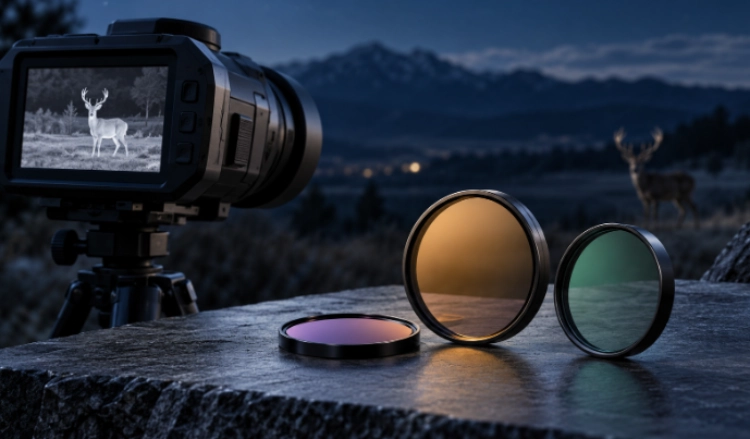
img.Infrared Filters for Night Thermal Imaging How to Match Passband, Blocking, and Detector Response.webp
What Should Engineers Define Before Choosing an Infrared Filter for Thermal Imaging?
Before choosing a coating structure or substrate, engineers need to define what the camera is expected to detect. A filter can have strong transmission on its own and still perform poorly after integration if its spectral window does not match the detector.
Start with the Useful Infrared Spectral Window
Important atmospheric transmission windows occur approximately at 1–3 μm, 3–5 μm, and 8–13 μm. For thermal imaging systems, the 3–5 μm and longer 8–13 μm regions lead to different detector, substrate, and coating requirements.
A buyer asking how to choose an infrared filter for thermal imaging should therefore begin with the wavelength interval that contributes useful information to the system. A camera designed around the 3–5 μm region should not be specified in the same way as a longer-wave system simply because both are described as thermal imaging devices.
Target temperature, detector sensitivity, lens transmission, and the intended optical window all affect this decision.
Match Filter Transmission to Detector Response
The filter determines which radiation reaches the detector, while the detector determines which part of that radiation can become a useful signal. The two curves therefore need to be evaluated together.
In an infrared imaging chain, the lens, infrared filter, and focal-plane detector operate as an integrated optical system. This is why infrared filters for thermal imaging should not be approved only from an isolated filter curve.
For procurement, the detector response curve should be treated as part of the filter specification package. Instead of requesting only an “MWIR filter” or “LWIR filter,” define the detector-sensitive wavelength interval, the portion that must remain highly transmissive, and the wavelengths that require blocking. The same filter curve can produce different system results on two detectors with different response limits, so passband approval should be based on the actual detector used in the camera.
For an MWIR thermal imaging filter, for example, the filter should preserve the useful part of the detector response without unnecessarily extending transmission into other sensitive spectral regions.
Separate Useful Signal from Out-of-Band Radiation
Passband and blocking range solve two different parts of the same problem. The passband defines what should reach the detector. The blocking region defines what should be suppressed.
Filter performance can be evaluated through transmittance, reflectance, and absorbance, together with parameters such as the high-transmittance region, blocking region, and peak transmittance. A specification that states only “high transmission” is therefore incomplete.
A filter with strong peak transmission can still be a poor system match if its passband clips part of the detector’s useful response or allows unnecessary radiation into another detector-sensitive region. The first problem reduces available signal; the second can increase unwanted background or interference.
For this reason, buyers should review the passband and infrared filter blocking range against the complete detector response curve rather than comparing peak-transmission percentages alone.
Which Infrared Filter Type Fits Different Thermal Imaging Architectures?
Once the useful and unwanted wavelength regions are defined, the appropriate filter architecture becomes easier to identify. Long pass, broadband pass, and anti-reflection designs solve different optical problems and should not be treated as interchangeable products.
Long Pass Filters for Longer-Wavelength Thermal Detection
A long pass design transmits wavelengths beyond a defined transition region while suppressing shorter wavelengths. It becomes relevant when the system needs to retain the longer-wavelength side of the spectrum rather than isolate a bounded window.
When the camera architecture requires transmission beyond a defined cut-on point, BoDian’s Infrared Long Wave Pass Filter category provides a suitable starting point for specification work.
For an LWIR thermal imaging filter requirement, buyers should define the required transition region, useful transmission interval, blocking range, substrate, dimensions, and detector response before finalizing the coating design.
Long Pass Filter is one of the most relevant BoDian product families when the thermal imaging architecture requires transmission beyond a defined cut-on wavelength. It should not, however, be treated as the default choice for every thermal camera. If the useful detector response occupies a bounded spectral window, a broadband pass design may provide a more appropriate spectral match.
Broadband Pass Filters for Wider Infrared Signal Collection
A broadband pass filter serves a different requirement. Rather than transmitting everything beyond a cut-on point, it preserves a defined spectral window while rejecting wavelengths outside that region.
BoDian classifies a filter as broadband when its half-bandwidth exceeds 6% of the center wavelength, while narrower relative bandwidths fall into the narrowband category.
The Infrared Broadband Pass Filter category can therefore fit systems where a wider infrared window needs to reach the detector without leaving the long-wavelength side continuously open.
For infrared filters for thermal imaging used in this type of architecture, the key purchasing question is not whether broadband transmission is “better,” but whether the transmitted window corresponds to the detector-sensitive region the camera actually uses.
Anti-Reflection Filters for Lower Optical Interface Losses
Anti-reflection filters address another part of the optical chain. Their role is not to replace long pass or broadband filtering for primary wavelength selection. They are used to reduce reflection at optical interfaces within the required operating region.
The Infrared Anti-Reflection Filter category is relevant when the correct spectral region has already been defined but reflection losses also need to be controlled.
This distinction is important during procurement. A requirement for deeper out-of-band blocking and a requirement for lower in-band reflection are different engineering problems and should appear separately in the specification.
Which Filter Specifications Matter Most Before Purchase?
Selecting the filter family is only one step. Buyers also need to translate camera requirements into measurable optical and mechanical acceptance criteria. For infrared filters for thermal imaging, passband, blocking, substrate, clear aperture, and surface condition should be considered together.
Passband and Transmission Requirements
Transmission should be specified across the useful wavelength interval rather than at only one favorable wavelength.
BoDian can support suitable high-precision filter designs with transmission above 90% and cutoff depth reaching OD6 or higher. These figures are capability examples, not universal specifications for every infrared product, so the final achievable values should be confirmed for each coating design.
The buyer should define whether a transmission target is a minimum value, an average across a range, or a requirement at specific wavelengths. This prevents a peak-transmission figure from being mistaken for complete passband performance.
Blocking Range and Optical Density
A strong passband does not compensate for inadequate rejection. If the detector remains sensitive outside the intended window, spectral leakage can still contribute unwanted signal.
Blocking requirements should therefore specify both the wavelength range and the required rejection level. Optical density is useful when deep blocking must be quantified, but increasing OD without considering actual detector response can add manufacturing difficulty without improving camera performance.
Tighter rejection, steeper spectral edges, and narrower tolerances generally increase coating-design and manufacturing difficulty. The useful question is therefore not “What is the highest OD available?” but “What rejection is required to keep unwanted radiation below the system’s acceptable level?”
Substrate, Clear Aperture, and Surface Quality
Spectral performance also depends on the substrate and mechanical design. Available infrared optical materials can include germanium, silicon, sapphire, calcium fluoride, zinc sulfide, and zinc selenide. Their transmission characteristics differ, so the substrate must suit the operating wavelength as well as the mounting and environmental requirements.
Clear aperture should also be separated from total component size. Mounting areas, coating edges, and usable optical area can affect how much of the component actually participates in imaging.
Surface condition matters as well. For polished infrared optics, edge damage, cracks, coating defects, or unsuitable surface quality can create integration risks even if the nominal spectral curve is acceptable.
How Can Buyers Validate a Filter Before Camera Integration?
A coating design is not complete from a procurement perspective until its finished performance can be tested against the agreed specification. This becomes especially important when passband and blocking limits are tied closely to detector response.
Verify Spectral Performance Across the Required Range
Transmittance, reflectance, and absorbance can be measured across ultraviolet, visible, and infrared wavelength regions using spectrometer-based testing.
For infrared filters for thermal imaging, the test range should cover both the useful passband and all blocking regions relevant to the detector. A single peak-transmission value does not show whether leakage exists elsewhere in the detector-sensitive range.
Supplier and customer should also agree on test conditions and acceptance criteria before production where the spectral requirement is tight.
Evaluate the Filter in the Complete Optical Path
The final camera should be evaluated as a system consisting of the lens, filter, detector, and other optical interfaces.
A filter may meet its component specification while the assembled camera still shows unwanted reflections, insufficient thermal contrast, detector noise, or losses elsewhere in the optical chain. Those problems should not automatically be assigned to the filter.
For a more application-focused discussion of spectral filtering and nighttime image performance, see How Infrared Filters Improve Thermal Camera Imaging in Low Light Conditions.
Confirm Coating Consistency and Test Requirements
Optical thin-film production involves both coating control and post-coating verification. BoDian uses processes including magnetron sputtering and vacuum evaporation, with spectral testing integrated into production and inspection.
For repeat orders, buyers should clarify which spectral values will be inspected, what physical defects are unacceptable, and whether the same measurement conditions will be maintained across batches.
This is more useful than relying on a general catalog description because repeatability must be judged against the approved specification.
What Should Buyers Send BoDian Optical for a Custom Thermal Imaging Filter?
A useful RFQ should give the optical engineer enough information to judge both feasibility and manufacturing requirements. For infrared filters for thermal imaging, the detector response curve is particularly valuable because it connects passband and blocking requirements to the real camera architecture.
Define Wavelength, Blocking, Size, and Substrate Requirements
For a custom infrared filter for thermal camera integration, buyers should provide the target passband or cut-on region, required blocking range, transmission target, detector-sensitive wavelength interval, dimensions, clear aperture, substrate preference, operating conditions, and expected inspection requirements.
If a substrate has not yet been fixed, the operating spectral range and mechanical requirements should be supplied first so that material compatibility can be considered during design.
Select the Product Category Before Final Customization
Choose a Long Pass Filter when the useful signal extends beyond a defined transition toward longer wavelengths.
Choose a Broadband Pass Filter when the detector needs a wider but bounded spectral window.
Choose an Anti-Reflection Filter when reflection loss within an already-defined operating region is the main optical concern.
This order keeps the product category tied to the actual system function rather than forcing the camera requirement to fit an existing filter description.
Contact BoDian Optical for Custom Design Support
If your project already has a detector response curve, target wavelength region, blocking requirement, or mechanical drawing, you can contact BoDian Optical with those details. Wavelength selection, substrate compatibility, dimensions, coating structure, and test conditions can then be reviewed before the final specification is fixed.
The most reliable way to source infrared filters for thermal imaging is to work backward from the detector and scene requirements: define the useful response, identify unwanted radiation, choose the filter architecture, and then set measurable optical and mechanical acceptance limits.
FAQ
Do thermal cameras need visible light to work at night?
Thermal cameras detect infrared radiation rather than depending on visible illumination. Image performance still depends on target-to-background thermal contrast, detector response, optical losses, and unwanted spectral radiation. This is why infrared filters for thermal imaging should be matched to the detector and optical path rather than selected according to visible-light brightness alone.
Should every LWIR thermal camera use a long pass filter?
No. A long pass design is appropriate when the required spectrum extends beyond a defined cut-on wavelength. If the detector needs a bounded spectral window, a broadband pass design may be more suitable. The detector response curve and unwanted spectral regions should determine the filter architecture.
What information is most useful when ordering a custom thermal imaging filter?
Provide the detector response range, desired passband or cut-on wavelength, blocking range, transmission target, substrate or material constraints, dimensions, clear aperture, operating conditions, and test requirements. These details make it possible to evaluate the filter as part of the complete camera rather than as an isolated optical component.