English
 Afrikaans
 Albanian
 Amharic
 Arabic
 Armenian
 Azerbaijani
 Basque
 Belarusian
 Bengali
 Bosnian
 Bulgarian
 Catalan
 Cebuano
 Chichewa
 Chinese (Simplified)
 Chinese (Traditional)
 Corsican
 Croatian
 Czech
Czech Danish
 Dutch
Dutch Esperanto
 Estonian
 Filipino
 Finnish
 French
 Frisian
 Galician
 Georgian
 German
 Greek
Greek Gujarati
 Haitian Creole
 Hausa
Hausa Hawaiian
 Hebrew
 Hindi
Hindi Hmong
Hmong Hungarian
 Icelandic
 Igbo
Igbo Indonesian
 Irish
Irish Italian
 Japanese
 Javanese
 Kannada
 Kazakh
 Khmer
Khmer Korean
 Kurdish (Kurmanji)
 Kyrgyz
 Lao
Lao Latin
Latin Latvian
 Lithuanian
 Luxembourgish
 Macedonian
 Malagasy
 Malay
Malay Malayalam
 Maltese
 Maori
Maori Marathi
 Mongolian
 Myanmar (Burmese)
 Nepali
 Norwegian
 Pashto
 Persian
 Polish
 Portuguese
 Punjabi
 Romanian
 Russian
 Samoan
 Scottish Gaelic
 Serbian
 Sesotho
 Shona
Shona Sindhi
 Sinhala
 Slovak
 Slovenian
 Somali
 Spanish
 Sundanese
 Swahili
 Swedish
 Tajik
Tajik Tamil
Tamil Telugu
 Thai
Thai Turkish
 Ukrainian
 Urdu
Urdu Uzbek
Uzbek Vietnamese
 Welsh
Welsh Xhosa
Xhosa Yiddish
 Yoruba
 Zulu
Zulu


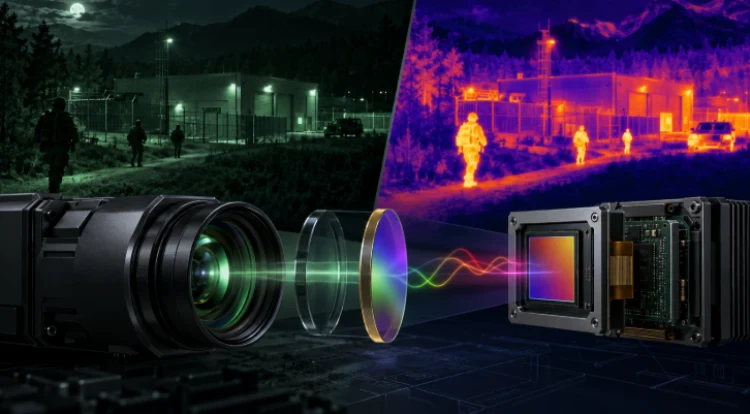
For camera engineers and OEM buyers comparing night vision vs infrared, the first question should not be which technology sounds more advanced. The practical question is what optical signal the system must detect. Low-light imaging uses available reflected light, active NIR introduces its own illumination, while thermal imaging detects infrared radiation emitted by the target.
BoDian Optical develops optical thin-film products for imaging, infrared detection, sensing, temperature measurement, automotive systems, and safety monitoring. Its infrared portfolio includes long-pass, short-pass, broadband, narrowband, and anti-reflection filters. The company can also adapt wavelength, dimensions, and coating design to project requirements.
For system designers, filter selection comes after the signal path, detector response, and useful spectral region have been defined.
Are Night Vision and Infrared Imaging Actually Different Technologies?
The terms are often treated as two parallel camera categories. From an optical-system perspective, that is too simple. A useful night vision vs infrared comparison starts by separating an imaging capability from a spectral region.
Night Vision Describes an Imaging Capability
Night vision describes the ability to produce a usable image under low-light or nighttime conditions. It does not define one fixed wavelength band or one detector architecture.
One system may depend on weak ambient illumination, while another uses near-infrared illumination that is reflected from the target. Both can support nighttime imaging, yet they place different requirements on the source, detector, lens, and filter.
For a system buyer, a more useful question is therefore: What radiation is actually reaching the detector?
Infrared Covers Multiple Spectral Regions
Infrared spans roughly 0.75 to 1000 μm and includes near-, mid-, and far-infrared regions. Important atmospheric transmission windows include approximately 1–3 μm, 3–5 μm, and 8–13 μm.
That broad spectral range matters in camera design. An active NIR camera receiving reflected illumination is not optically equivalent to a thermal camera operating at much longer wavelengths.
Treating every “infrared camera” as the same system can therefore lead to the wrong detector, material, or filter specification.
Active NIR and Thermal Imaging Use Different Signal Paths
In active infrared night vision, the basic signal path is:
IR illumination → target → reflected NIR → detector
Thermal imaging uses a different chain:
target emission → optical system → detector
The first depends on reflected energy from an added source. The second measures radiation emitted by the target.
For readers who first need the broader technology comparison, Night Vision vs. Infrared: Which Technology Dominates the Dark? provides additional background. The system-design task begins once the signal source has been identified.
What Signal Does Each Night Imaging System Actually Detect?
A camera responds to radiation that reaches its detector within a useful spectral range. Mapping this path before selecting components helps prevent a filter specification from being based only on the camera category.
Low-Light Imaging Uses Available Reflected Light
Low-light imaging requires usable illumination in the scene. Moonlight, starlight, or artificial lighting can strike a target and return through the optical system to the sensor.
Detector sensitivity is only one part of that chain. Lens transmission, protective windows, spectral losses, and background radiation can all influence how much useful signal reaches the sensor.
This architecture is intended to preserve reflected scene information rather than detect thermal emission.
Active NIR Adds Infrared Illumination to the Scene
An active NIR system supplies its own infrared illumination and measures the light reflected by the target.
Its filter strategy should therefore be linked to the illuminator wavelength and detector response. A filter may need to preserve the useful return while reducing visible or off-band radiation that does not contribute to the desired image.
This is one reason a filter developed for active NIR should not automatically be transferred to thermal imaging, even though both systems may be described as infrared cameras.
Thermal Imaging Detects Radiation Emitted by the Target
In a thermal imaging system, emitted radiation, the optical path, spectral filter, and detector operate as one measurement chain.
Objects above absolute zero emit infrared radiation, while the amount and spectral distribution of that radiation vary with temperature. Infrared filters are therefore used upstream of detectors in applications that include imaging, sensing, temperature measurement, and monitoring.
The filter is not an isolated accessory. Its useful passband has to serve the detector and the measurement task.
Which Night Imaging Architecture Fits Different Operating Conditions?
A practical night vision vs infrared decision should start with operating conditions and measurement goals. The system should be selected around the signal that remains available in the real scene.
| Operating Need | Low-Light Imaging | Active NIR | Thermal Imaging |
| Main signal | Reflected ambient light | Reflected NIR illumination | Emitted infrared radiation |
| Added illumination | Not always | Yes | Not required for thermal signal |
| Scene-detail priority | High | High | Depends on thermal contrast |
| Thermal information | No | No | Yes |
| Filter focus | Preserve useful sensor band | Match source and detector | Match detector and emitted signal |
Available Ambient Light Supports Reflected-Light Imaging
Where usable illumination remains, reflected-light imaging can preserve visual details that help with recognition and scene interpretation.
For system integration, the question is whether enough useful spectral energy survives the complete optical path. More scene illumination does not automatically improve the image if a large part of that radiation lies outside the detector’s effective response.
Complete Darkness Requires an Independent Signal Source
When useful ambient light disappears, the camera needs another source of information.
Active NIR provides illumination and observes its reflection. Thermal imaging does not need reflected scene illumination because it uses radiation emitted by the target.
This is why night vision vs infrared has no useful one-line answer such as “technology A is always better.” The correct architecture depends on whether the task requires reflected scene detail, operation without ambient illumination, or thermal information.
Detection, Identification, and Temperature Measurement Require Different Architectures
A system detecting the presence of a person is not necessarily solving the same problem as one identifying visual details or measuring temperature-related radiation.
BoDian Optical’s infrared products are used in infrared detection, thermal imaging, temperature measurement, automotive applications, electronics, and safety monitoring.
The measurement objective should therefore be defined before the optical filter is specified.
Why Do Wavelength, Detector Response, and Filters Change Camera Performance?
Once the night vision vs infrared architecture is established, the system-design problem becomes more specific: which wavelengths contain useful information, which wavelengths can the detector receive, and which radiation should the filter suppress?
Detector Response Defines the Useful Spectral Window
A detector can only convert radiation inside its usable response range into a meaningful signal. The passband should therefore be selected from the detector response, target signal, optical materials, and operating environment.
This is especially important in infrared camera filter selection. Two cameras may both be described as infrared systems while operating in very different spectral regions.
For an LWIR detector, filter selection should begin with the detector and target band rather than with the generic label “thermal camera.”
Optical Filters Control What Reaches the Detector
Optical filters use thin-film structures to modify transmission, reflection, and absorption across wavelength.
Relevant filter specifications include transmittance, reflectance, absorbance, high-transmission region, blocking region, and peak transmittance.
For a camera using a long-pass filter, the design task is not simply to “pass infrared.” The filter must transmit the required spectral region while controlling radiation that should not contribute to the detector signal.
The same system-level logic applies to thermal imaging optical filter selection.
Filter Selection Must Be Validated Across the Complete Optical Path
Filter performance should be considered together with detector response, substrate, lens transmission, protective windows, and operating geometry.
BoDian Optical works with infrared substrate materials including germanium, silicon, zinc sulfide, and calcium fluoride. Its production capability includes vacuum evaporation and magnetron sputtering, while its spectroscopy equipment can evaluate transmittance, reflectance, and absorbance across ultraviolet, visible, and infrared regions.
For custom infrared projects, this matters because a spectral design has to be translated into a repeatable coated component and then verified. OEM buyers should compare the required passband and blocking specification with measured finished-part performance rather than treating the theoretical design as the final acceptance result.
Before moving into specific LWIR models, the filter category should follow the imaging architecture rather than the general “night vision” label. A low-light system should preserve the spectral region carrying useful reflected detail. An active-NIR system should match the illuminator, target return, and detector response. A thermal system should define its passband from emitted radiation and detector response. Only after this step does it make sense to compare individual long-wave filters.
Which BoDian Optical Filter Fits Your Thermal Imaging Design?
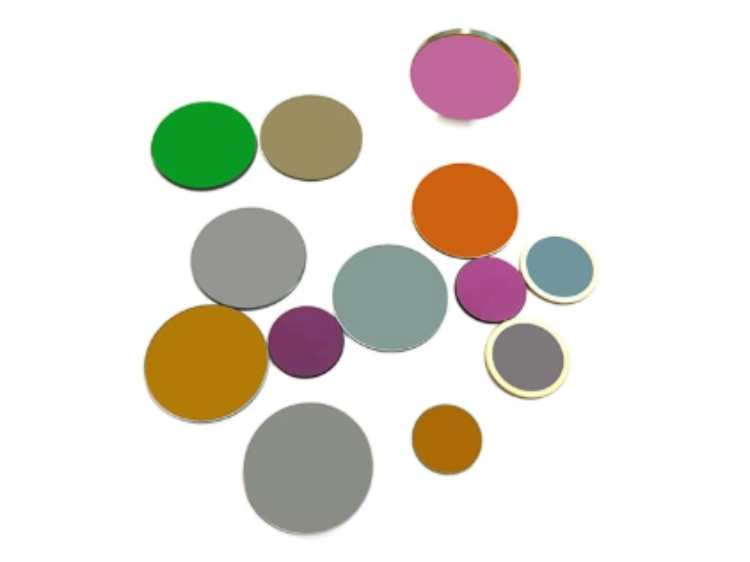
For night vision vs infrared projects that ultimately require LWIR thermal detection, BoDian Optical offers several Infrared Long Wave Pass Filter designs with different transmission regions. They should be compared by the detector band and optical requirement rather than treated as interchangeable products.
ILP8200 Fits Broad 9–14 μm Thermal Imaging Requirements
The ILP8200 Infrared Long Wave Pass Filter uses a Ge substrate and has a listed high-transmission region of 9000–14000 nm with Tp ≥80%.
Its range makes it relevant for systems intended to work across a broad LWIR region. Before specification, buyers should still verify detector response, lens transmission, blocking targets, and mechanical requirements.
ILP10600 Targets Deeper LWIR Thermal Detection
The ILP10600 Infrared Long Wave Pass Filter uses a Ge substrate, with a listed high-transmission region of 11000–14000 nm and Tp ≥90%. Its stated applications include security monitoring and thermal radiation measurement.
Compared with ILP8200, its transmission begins farther into the long-wave region. It is therefore more relevant when the detector architecture specifically targets that deeper LWIR interval.
ILP7700 Supports High-Transmission LWIR Designs
The ILP7700 Infrared Long Wave Pass Filter uses a Ge substrate and covers 7900–11000 nm, with a listed Tp ≥90%.
Its transmission window is shorter than the other two models. It can be evaluated where detector response is centered in that region and higher listed peak transmission is important to the optical budget.
| Design Direction | High-Transmission Region | BoDian Optical Model |
| Broad LWIR imaging | 9000–14000 nm | ILP8200 |
| Deeper LWIR detection | 11000–14000 nm | ILP10600 |
| Shorter LWIR region | 7900–11000 nm | ILP7700 |
A good procurement specification should state the signal source, detector response, target passband, blocking requirement, substrate, dimensions, and operating geometry. For a project where a standard filter does not match these conditions, BoDian Optical can customize wavelength, size, and coating design and can work from customer samples or drawings.
If your engineering team already has detector-response curves, passband targets, blocking requirements, dimensions, or optical drawings, sending those details through the contact channel gives the filter discussion a much clearer technical starting point. For night vision vs infrared projects, defining the actual signal path first will usually eliminate more selection errors than comparing camera labels alone.
FAQ
What is the main difference in night vision vs infrared imaging?
Night vision describes an imaging capability in low-light or nighttime conditions, while infrared describes a spectral region. Low-light imaging can use reflected ambient light, active NIR uses reflected infrared illumination, and thermal imaging detects emitted infrared radiation. The correct architecture depends on the signal the system needs to detect.
How should an active NIR camera filter be selected?
Start with the illuminator wavelength and detector response. The filter should preserve the useful reflected NIR signal while controlling visible or other off-band radiation where required. It should not be selected from thermal-camera filter specifications simply because both systems operate outside the visible range.
How should engineers choose between ILP8200, ILP10600, and ILP7700?
Start with the detector’s required spectral region. ILP8200 covers 9000–14000 nm, ILP10600 covers 11000–14000 nm, and ILP7700 covers 7900–11000 nm. Detector response, blocking needs, substrate compatibility, lens transmission, and system geometry should then be checked before the model is finalized.