English
 Afrikaans
 Albanian
 Amharic
 Arabic
 Armenian
 Azerbaijani
 Basque
 Belarusian
 Bengali
 Bosnian
 Bulgarian
 Catalan
 Cebuano
 Chichewa
 Chinese (Simplified)
 Chinese (Traditional)
 Corsican
 Croatian
 Czech
Czech Danish
 Dutch
Dutch Esperanto
 Estonian
 Filipino
 Finnish
 French
 Frisian
 Galician
 Georgian
 German
 Greek
Greek Gujarati
 Haitian Creole
 Hausa
Hausa Hawaiian
 Hebrew
 Hindi
Hindi Hmong
Hmong Hungarian
 Icelandic
 Igbo
Igbo Indonesian
 Irish
Irish Italian
 Japanese
 Javanese
 Kannada
 Kazakh
 Khmer
Khmer Korean
 Kurdish (Kurmanji)
 Kyrgyz
 Lao
Lao Latin
Latin Latvian
 Lithuanian
 Luxembourgish
 Macedonian
 Malagasy
 Malay
Malay Malayalam
 Maltese
 Maori
Maori Marathi
 Mongolian
 Myanmar (Burmese)
 Nepali
 Norwegian
 Pashto
 Persian
 Polish
 Portuguese
 Punjabi
 Romanian
 Russian
 Samoan
 Scottish Gaelic
 Serbian
 Sesotho
 Shona
Shona Sindhi
 Sinhala
 Slovak
 Slovenian
 Somali
 Spanish
 Sundanese
 Swahili
 Swedish
 Tajik
Tajik Tamil
Tamil Telugu
 Thai
Thai Turkish
 Ukrainian
 Urdu
Urdu Uzbek
Uzbek Vietnamese
 Welsh
Welsh Xhosa
Xhosa Yiddish
 Yoruba
 Zulu
Zulu


Infrared transmission through the atmosphere is not uniform. Water vapor, carbon dioxide, methane, ozone, and other atmospheric components absorb radiation at particular wavelengths, while other spectral regions allow much more energy to reach an infrared detector. For an optical engineer, the practical question is therefore not simply whether the atmosphere absorbs infrared, but which wavelengths should be transmitted, rejected, or deliberately isolated.
BoDian Optical develops optical thin-film products for infrared detection, gas analysis, spectral measurement, thermal imaging, and related systems. Its infrared product range includes narrow bandpass, broadband pass, long-pass, short-pass, and anti-reflection filters, allowing filter architecture to be selected around the required spectral task rather than around a single generic infrared specification.

Why Does the Atmosphere Absorb Infrared Radiation Selectively?
Atmospheric gases are not solid opaque objects but rather greatly different by wavelength. Hence an infrared source can travel long distances in certain spectral regions whereas in others it will be attenuated greatly within a few km.
Molecular Absorption Depends on Wavelength
Infrared radiation interacts with gas molecules through wavelength-dependent molecular energy transitions. This results in atmospheric infrared absorption being displayed as spectral bands, as opposed to equal attenuation across the complete infrared range.
This distinction matters in system design. An imaging system may be designed to work inside a relatively transparent atmospheric region, while a gas analyzer may intentionally look at a wavelength where the target gas absorbs strongly. The same atmosphere is therefore either a transmission medium or part of the measurement mechanism, depending on the application.
Absorption and Scattering Affect Signals Differently
Molecular absorption removes energy from specific spectral regions while aerosols, dust, fog and clouds can also scatter light away from the optical path. This must not be confused with the above-mentioned effects.
The narrow spectral channel helps to reject unwanted wavelengths, but cannot remove losses due to clouds or strongly scattering aerosol layers. Filter selection therefore has to be separated from atmospheric-path assessment.
Humidity and Optical Path Conditions Change Transmission
Open-path infrared sensors can be greatly affected by changing environmental conditions. The background spectrum can shift due to effects such as water-vapor absorption, changes in temperature and humidity, scattering by aerosols, and other interference along the optical path and affecting the gas measurement.
When dealing with long paths it is not sufficient to evaluate the infrared transmission through the atmosphere by means of a filter curve. The laboratory specification of the transmission has to be checked for its applicability under real operating conditions, i.e. taking into account humidity, path length, cloud cover etc. as well as detector characteristics at the site of installation.
Which Atmospheric Components Most Affect Infrared Transmission?
Different atmospheric components create different problems. Some produce broad, variable attenuation, while others create narrower spectral features that can be useful for selective gas measurement.
Water Vapor Creates Broad and Variable Absorption
Water vapor is difficult to treat as a fixed interference because its concentration changes with humidity, altitude, weather, and location. A dry test environment and a humid field installation can therefore produce different transmission conditions even when the same source, filter, and detector are used.
For applications that depend on infrared transmission through the atmosphere, water vapor should be treated as part of the optical path specification. This is particularly relevant to remote sensing and open-path measurements where the path itself may be much longer than the optical path inside the instrument.
CO₂ and CH₄ Provide Gas-Specific Spectral Targets
Carbon dioxide and methane are different from broad atmospheric background effects because their characteristic infrared absorption regions can be used as measurement channels. Instead of avoiding all absorption, a gas detector can place a spectral channel near the target feature and compare the received energy with a reference or background channel.
This is why the question what gases absorb infrared radiation has direct engineering value. Knowing that a gas absorbs infrared is only the first step; the detector system must also know where that absorption occurs and how narrowly the optical channel should be defined.
Ozone, Nitrous Oxide, Aerosols, and Clouds Add Spectral Interference
Other gases can contribute additional spectral features, while aerosols and clouds add absorption and scattering to the optical path. Thick cloud layers can strongly reduce useful infrared energy, while thinner clouds may still pass part of the signal depending on wavelength and cloud properties.
For a broader absorber-by-absorber discussion, the earlier guide on what absorbs infrared light in the atmosphere provides additional background. The more useful next step for system design is to identify the wavelength regions where transmission remains practical.
Where Are the Main Infrared Atmospheric Windows?
The atmosphere contains relatively favorable spectral regions commonly called infrared atmospheric windows. These windows are central to detector, imaging, and remote-sensing design because they show where atmospheric loss can be lower than in neighboring absorption bands.
The 1–3 µm, 3–5 µm, and 8–13 µm Transmission Windows
Infrared technical material identifies three significant atmospheric transmission regions at approximately 1–3 µm, 3–5 µm, and 8–13 µm. These ranges have consequently become important reference bands for infrared system development.
An atmospheric window should not be read as a guarantee of 100% transmission. It means that the wavelength region is comparatively favorable for propagation. Actual infrared transmission through the atmosphere still depends on the path and environmental conditions.
Atmospheric Windows Still Change with Real Conditions
Humidity, aerosols, temperature variation, and optical-path disturbances can modify the spectrum even when a system operates inside a recognized window.
For procurement, this is an important distinction. A buyer specifying only “3–5 µm operation,” for example, has not yet defined enough information for final filter selection. The system may still require a narrower channel, specific blocking outside the passband, or accommodation for the detector response.
Transmission Windows and Absorption Bands Serve Different Systems
A thermal or remote-sensing system commonly tries to collect useful radiation through a transmission window. A gas detector may do the opposite: it deliberately measures a gas-specific absorption feature.
This leads to two different optical design questions:
| System Goal | Spectral Strategy | Filter Requirement |
| Observe or image through the atmosphere | Work within a useful transmission region | Pass the required detector band and suppress unwanted radiation |
| Detect a specific gas | Isolate a molecular absorption feature | Use a narrow spectral channel with controlled out-of-band blocking |
This distinction prevents a common sourcing mistake: choosing a filter simply because its wavelength lies inside the infrared region.
How Should Filters Be Selected for Atmospheric Infrared Measurements?
Once the spectral objective has been defined, the filter can be selected around the target channel, detector, and interference sources. For gas analysis, bandwidth and blocking are often as important as the nominal center wavelength.
Infrared Narrow Bandpass Filters Isolate Target Spectral Channels
An Infrared Narrow Bandpass Filter is designed to transmit a restricted infrared region while suppressing radiation outside that band. BoDian Optical’s filter terminology uses center wavelength, high-transmission region, blocking region, peak transmittance, and bandwidth to describe this spectral behavior; its internal product classification treats a half bandwidth within about 6% of the center wavelength as narrowband.
For an infrared narrow bandpass filter for gas detection, the buyer should therefore compare the target absorption feature with the complete transmission curve, not just the model’s nominal wavelength.
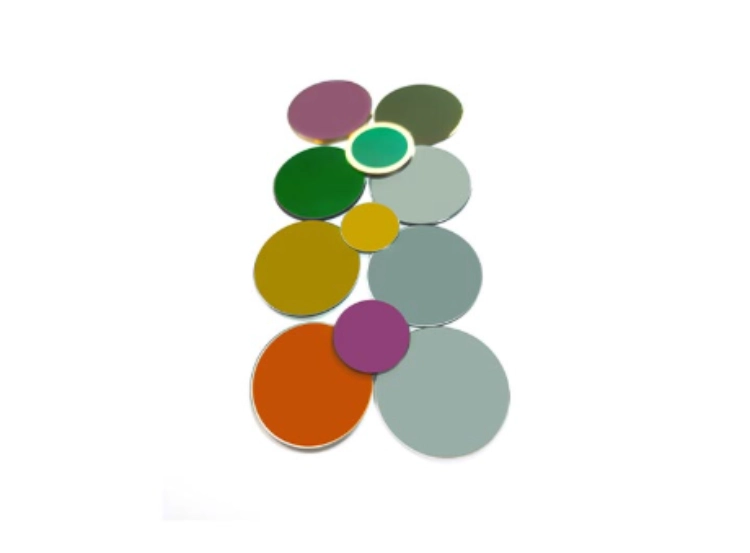
INBP4260 Supports a CO₂ Detection Channel
INBP4260 is identified as a CO₂ Gas Detection Filter. Its listed specification uses a sapphire substrate, a center wavelength of 4260 ±45 nm, an HPB of 135 ±20 nm, peak transmittance of ≥92%, and blocking from 400 to 11000 nm at T<1%.
These values make the product a useful example of how a CO2 gas detection filter is specified. The decision is not “CO₂ needs an infrared filter”; the actual question is whether the CWL, bandwidth, blocking range, detector response, and optical geometry fit the intended measurement channel.
INBP3375 Supports a CH₄ Detection Channel
For methane measurement, INBP3375 uses a different spectral specification: sapphire substrate, 3375 ±10 nm CWL, 40 ±5 nm HPB, Tp ≥75%, and 400–11000 nm blocking at T<1%.
The difference between INBP3375 and INBP4260 illustrates why a methane gas detection filter and a CO₂ channel should not be treated as interchangeable products. Even within the same filter category, target wavelength and required bandwidth change with the gas and measurement architecture.
What Should Buyers Confirm Before Ordering an Infrared Filter?
A filter specification should begin with the function of the complete optical system. The target spectral feature, detector, optical geometry, and unwanted radiation determine what the filter must actually do.
Define the Optical Specification Before Choosing the Filter
For narrowband filters, useful specification items include peak wavelength, peak transmittance, bandwidth, rejection or blocking requirements, and acceptance angle. Optical-filter design guidance also stresses that filter performance should be derived from the system purpose and balanced against what can realistically be manufactured and tested.
A practical RFQ should therefore state the target gas or atmospheric window, required CWL and bandwidth, blocking range, detector response, angle of incidence, substrate dimensions, and operating environment.
Custom Coating and Spectral Testing Reduce Integration Risk
BoDian Optical supports wavelength, size, and coating-design customization, and its infrared products are used in gas detection, temperature measurement, infrared detection, and imaging. Its technical resources also cover transmittance, reflectance, and absorbance measurements across ultraviolet, visible, and infrared ranges.
For custom work, spectral verification is useful before the filter is treated as a finished system component. It can reveal whether the passband, blocking, and detector response align as intended.
Contact BoDian Optical for Application-Specific Filter Matching
For projects where infrared transmission through the atmosphere varies with gas type, optical path, or detector band, send the target wavelength, bandwidth, blocking requirement, AOI, substrate size, detector information, and working environment when making contact. This gives the technical team enough information to discuss a standard model, a modified specification, or a custom coating rather than selecting a filter from center wavelength alone.
For system designers, the key point is that infrared transmission through the atmosphere and filter transmission are two different parts of the same optical path. A useful filter must match both the atmospheric behavior and the measurement objective.
FAQ
What affects infrared transmission through the atmosphere?
The main factors include wavelength-dependent molecular absorption, especially from water vapor and gases such as CO₂ and CH₄, together with cloud, aerosol, humidity, and optical-path effects. Transmission therefore changes substantially across different infrared wavelength regions.
What gases absorb infrared radiation in atmospheric sensing systems?
Water vapor, carbon dioxide, methane, ozone, and nitrous oxide all have infrared absorption features. For a gas detector, the relevant issue is the target gas’s spectral band and whether the filter and detector can isolate that channel from surrounding radiation.
When should a gas detector use an Infrared Narrow Bandpass Filter?
A narrow bandpass filter is suitable when the system needs to isolate a defined spectral feature rather than collect a broad infrared range. Selection should consider CWL, bandwidth, peak transmission, blocking, detector response, AOI, and the atmospheric path rather than wavelength alone.