English
 Afrikaans
 Albanian
 Amharic
 Arabic
 Armenian
 Azerbaijani
 Basque
 Belarusian
 Bengali
 Bosnian
 Bulgarian
 Catalan
 Cebuano
 Chichewa
 Chinese (Simplified)
 Chinese (Traditional)
 Corsican
 Croatian
 Czech
Czech Danish
 Dutch
Dutch Esperanto
 Estonian
 Filipino
 Finnish
 French
 Frisian
 Galician
 Georgian
 German
 Greek
Greek Gujarati
 Haitian Creole
 Hausa
Hausa Hawaiian
 Hebrew
 Hindi
Hindi Hmong
Hmong Hungarian
 Icelandic
 Igbo
Igbo Indonesian
 Irish
Irish Italian
 Japanese
 Javanese
 Kannada
 Kazakh
 Khmer
Khmer Korean
 Kurdish (Kurmanji)
 Kyrgyz
 Lao
Lao Latin
Latin Latvian
 Lithuanian
 Luxembourgish
 Macedonian
 Malagasy
 Malay
Malay Malayalam
 Maltese
 Maori
Maori Marathi
 Mongolian
 Myanmar (Burmese)
 Nepali
 Norwegian
 Pashto
 Persian
 Polish
 Portuguese
 Punjabi
 Romanian
 Russian
 Samoan
 Scottish Gaelic
 Serbian
 Sesotho
 Shona
Shona Sindhi
 Sinhala
 Slovak
 Slovenian
 Somali
 Spanish
 Sundanese
 Swahili
 Swedish
 Tajik
Tajik Tamil
Tamil Telugu
 Thai
Thai Turkish
 Ukrainian
 Urdu
Urdu Uzbek
Uzbek Vietnamese
 Welsh
Welsh Xhosa
Xhosa Yiddish
 Yoruba
 Zulu
Zulu


Far-Infrared Imaging depends on more than detector sensitivity. The optical path must pass useful thermal radiation while limiting wavelengths and reflections that add noise, reduce contrast, or distort measurement. In automotive night vision, this affects thermal contrast; in industrial thermography, it affects measurement stability. Filter selection should therefore start with the detector, optical layout, working band, and measurement task rather than with a filter name alone.
BoDian Optical develops optical thin-film components across ultraviolet, visible, and infrared wavelengths. Its infrared range includes long-pass, short-pass, broadband, narrowband, and anti-reflection structures, with customization for wavelength, substrate, size, and coating design. These categories solve different problems: long-pass filters set a cut-on boundary, broadband filters confine transmission to a selected region, and anti-reflection designs reduce optical-interface loss.

Why Does Spectral Filtering Matter in Far-Infrared Imaging?
A thermal detector responds to the radiation that reaches it, not to the target alone. Lens materials, reflections, atmospheric transmission, and off-axis rays all influence the signal. A useful thermal imaging spectral filter must therefore match the full optical chain.
The Atmospheric Window Defines the Useful Thermal Imaging Range
Infrared radiation covers a broad spectrum, but practical systems work within selected transmission windows. For far-infrared imaging, the long-wave region is especially useful for passive observation of thermal radiation from objects near ambient temperature.
The filter should therefore be selected around the detector response and the useful radiation from the scene. A wider spectral range is not automatically more useful if part of that range contributes background energy rather than useful target contrast.
Transmission and Blocking Control the Signal Reaching the Detector
Filter performance is described through transmittance, reflectance, absorbance, high-transmission regions, and blocking regions.
For systems that need a long-wavelength cut-on, the ILP8200 Infrared Long Wave Pass Filter is a relevant reference for temperature detection, thermal radiation measurement, and related infrared systems. Buyers should compare the transmission transition with the detector response rather than approving the filter from its nominal cutoff description alone.
Different Filter Architectures Solve Different Optical Problems
Long-pass filters define a lower wavelength boundary. Broadband filters pass a selected wider region while suppressing light outside it. Anti-reflection filters serve another role: reducing reflection so more useful radiation reaches the detector.
In practice, these functions may appear in the same optical assembly. A wavelength-selection filter controls spectral content, while an anti-reflection treatment deals with losses at coated interfaces.
What Does an Automotive Night Vision System Require from an Infrared Filter?
Automotive thermal night vision must work without depending on visible scene illumination. Spectral control matters because the system must preserve thermal contrast across changing conditions and field angles.
Far-Infrared Broadband Filtering Supports Passive Thermal Detection
A broadband filter is useful when the detector needs a defined thermal window rather than all wavelengths above one cut-on point. In automotive thermal night vision, this helps limit detector input to the selected operating region.
The IWBP8075-9400 Infrared Broad-Band Pass Filter fits projects that require a controlled broadband transmission window. Buyers should compare its spectral curve with detector response, lens transmission, incidence conditions, and optical layout.
This comparison matters because a filter that transmits the intended region on its own may still be poorly matched to the rest of the camera.
Long-Pass Filtering Suppresses Shorter-Wavelength Interference
A long-pass filter is more suitable when the main requirement is to reject shorter wavelengths while allowing longer-wave radiation through the optical path.
For far-infrared imaging, compare cut-on behavior, blocking needs, substrate compatibility, and optical loss rather than choosing by nominal wavelength alone. ILP8200 is more suitable for this type of architecture than a broadband component when the upper useful range is already controlled by the detector or another optical element.
Incidence Angle Can Change Real Filter Performance
Thin-film interference filters are angle-sensitive. As the angle of incidence changes, the spectral response can move toward shorter wavelengths, so a curve measured near normal incidence may not represent every ray in a wide-field camera.
For vehicle optics, specify the expected incidence-angle range before approval. Wide field of view, tilted installation, or a converging beam can change the effective filter response and should be included during coating specification.
What Performance Priorities Change in Industrial Thermography?
Industrial thermography often focuses on repeatable thermal contrast or temperature-related measurement rather than simply locating a warm object in darkness.
Spectral Matching Should Follow the Measurement Target
The useful band depends on detector response, target temperature, optical window, and measurement goal.
In far-infrared imaging for industrial inspection, define the measurement target first. ILP8200 is more relevant where a long-wavelength cut-on is needed, while IWBP8075-9400 suits a bounded broadband window.
An industrial thermography filter should therefore be selected from the measurement chain backward: target radiation, detector response, optical window, filter, and lens should all be checked as one system.
High Optical Throughput Helps Preserve Weak Thermal Signals
Every optical surface can introduce reflection loss, and those losses accumulate before radiation reaches the detector.
An Infrared Anti-Reflection Filter can be considered when the goal is to reduce interface reflection and improve transmission into the sensor path. For the linked model, buyers should verify that the listed working range matches the intended far-infrared system before specification approval.
An infrared anti-reflection coating should not be treated as a replacement for a spectral filter. Its job is mainly to reduce optical loss across the required band.
Substrate and Coating Design Affect System Integration
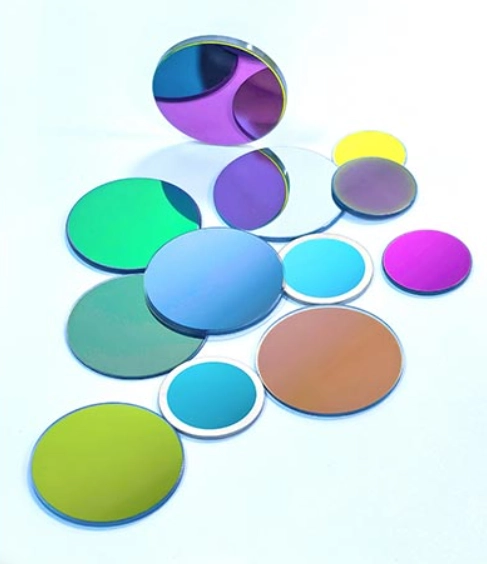
Infrared filters may use substrates such as germanium, silicon, sapphire, calcium fluoride, zinc sulfide, and zinc selenide. Selection depends on transmission range, mechanical role, and system wavelength.
Size, shape, surface quality, and clear aperture also matter. A coating can meet its spectral target yet still fail if the substrate or usable aperture does not fit the assembly.
For compact thermal modules, clear aperture deserves particular attention. The outer diameter may fit the holder while the usable optical area still clips part of the beam.
How Should Buyers Compare Long-Pass, Broadband, and Anti-Reflection Filters?
Start with the failure you need to prevent. If shorter wavelengths are entering the detector, consider long-pass filtering. If the detector should receive only a bounded thermal region, consider broadband filtering. If reflection loss is the main concern, evaluate an infrared anti-reflection coating.
| Filter Function | Main Selection Question | Typical Design Concern |
| Long-Pass | Where should transmission begin? | Cut-on position and short-wave blocking |
| Broadband | Which thermal window should pass? | Passband width and out-of-band rejection |
| Anti-Reflection | Where is useful energy being lost? | Reflection across the operating band |
ILP8200 Fits Systems That Need a Long-Wavelength Cut-On
ILP8200 should be evaluated when the optical architecture needs a defined transition into longer wavelengths. For procurement, request the spectral curve under the intended conditions and confirm substrate, dimensions, clear aperture, and incidence geometry.
This is more reliable than selecting a long-wave infrared filter from a wavelength label alone.
IWBP8075-9400 Fits a Controlled Broadband Thermal Window
IWBP8075-9400 is better aligned with a bounded thermal window. That can be useful where passing all wavelengths above a cut-on would introduce more background than the detector needs.
Compare transmission inside the working band with rejection outside it. System-level signal quality matters more than one peak transmission value.
Anti-Reflection Filtering Addresses Optical Loss Rather than Band Selection
An anti-reflection design should be judged by how well it reduces reflection across the actual operating band and incidence conditions. It may be used with a spectral filter when both wavelength control and interface efficiency matter.
In far-infrared imaging, an anti-reflection element cannot correct an incorrectly chosen passband, and a suitable passband cannot remove every interface loss.
How Should Buyers Move from Filter Selection to Custom Integration?
A procurement specification should turn the imaging requirement into measurable optical and mechanical conditions. This reduces the risk of discovering a mismatch after assembly.
Define Spectral, Substrate, Aperture, and Mechanical Requirements
Provide the required transmission region, blocking region, substrate preference, incidence-angle range, dimensions, shape, clear aperture, and surface requirements.
For an industrial thermography filter, define the detector band and measurement target before finalizing the coating. For automotive systems, include field angle and mounting space from the start.
A useful mechanical drawing should also identify the usable optical area and installation direction where these affect assembly.
Verify Spectral Performance before Production Approval
Spectral testing should cover the parameters that matter to the system, including transmittance, reflectance, and, where required, absorbance. Prototype evaluation is especially useful away from normal incidence or when several optical elements shape the final response.
Measured curves should be checked against detector and lens requirements rather than only against a generic catalog description.
This step is especially important for customized filters because spectral performance and mechanical integration must both remain inside the system specification.
Custom Filter Design and Technical Support Complete the Procurement Process
Custom work becomes useful when a standard filter cannot meet the required wavelength range, substrate, dimensions, or coating behavior. BoDian Optical supports thin-film development from coating design through spectral testing, with options for custom wavelength, size, substrate, and specifications.
For a Far-Infrared Imaging project, prepare the detector range, target spectral window, incidence conditions, mechanical drawing, and blocking requirement before supplier review. If the difficult part is choosing between long-pass, broadband, and anti-reflection structures, share those details through the contact page so the discussion starts from the actual optical system.
FAQ
Q: What type of filter is commonly used for far-infrared imaging?
A: It depends on the optical task. A long-pass filter is useful when shorter wavelengths must be rejected, while a broadband filter is better when the detector should receive a defined thermal window. Anti-reflection treatment addresses reflection loss and may be used alongside either approach.
Q: How do I choose between a long-pass and broadband infrared filter?
A: Start with detector response and the wavelength region carrying useful target information. Choose long-pass filtering when you mainly need a lower cut-on boundary. Choose broadband filtering when both lower and upper spectral limits matter. Then verify incidence angle, substrate, blocking behavior, and mechanical fit.
Q: Why does angle of incidence matter in Far-Infrared Imaging filters?
A: Thin-film interference behavior changes with incident angle, which can shift spectral response. Wide-field cameras and compact optical assemblies may send rays through the filter at different angles, so the filter should be evaluated under the geometry expected in the final system.