English
 Afrikaans
 Albanian
 Amharic
 Arabic
 Armenian
 Azerbaijani
 Basque
 Belarusian
 Bengali
 Bosnian
 Bulgarian
 Catalan
 Cebuano
 Chichewa
 Chinese (Simplified)
 Chinese (Traditional)
 Corsican
 Croatian
 Czech
Czech Danish
 Dutch
Dutch Esperanto
 Estonian
 Filipino
 Finnish
 French
 Frisian
 Galician
 Georgian
 German
 Greek
Greek Gujarati
 Haitian Creole
 Hausa
Hausa Hawaiian
 Hebrew
 Hindi
Hindi Hmong
Hmong Hungarian
 Icelandic
 Igbo
Igbo Indonesian
 Irish
Irish Italian
 Japanese
 Javanese
 Kannada
 Kazakh
 Khmer
Khmer Korean
 Kurdish (Kurmanji)
 Kyrgyz
 Lao
Lao Latin
Latin Latvian
 Lithuanian
 Luxembourgish
 Macedonian
 Malagasy
 Malay
Malay Malayalam
 Maltese
 Maori
Maori Marathi
 Mongolian
 Myanmar (Burmese)
 Nepali
 Norwegian
 Pashto
 Persian
 Polish
 Portuguese
 Punjabi
 Romanian
 Russian
 Samoan
 Scottish Gaelic
 Serbian
 Sesotho
 Shona
Shona Sindhi
 Sinhala
 Slovak
 Slovenian
 Somali
 Spanish
 Sundanese
 Swahili
 Swedish
 Tajik
Tajik Tamil
Tamil Telugu
 Thai
Thai Turkish
 Ukrainian
 Urdu
Urdu Uzbek
Uzbek Vietnamese
 Welsh
Welsh Xhosa
Xhosa Yiddish
 Yoruba
 Zulu
Zulu


In the quick-paced fields of self-driving vehicles, factory measurement, and medical tools, the 1064nm wavelength serves as a steady base. This near-infrared (NIR) light works well for Nd:YAG and fiber laser setups. It strikes a good match between air passage and detector response. Yet, system accuracy depends on pulling out this light from a messy mix of sun glare and other disruptions. Top results call for strong 1064nm bandpass filters. These hold up in tough spots and keep clear light paths. Such tools boost overall function in real-world use.
At BoDian Optical, thin-film work draws on more than 40 years of study in light behavior. The focus goes beyond parts alone. It builds the core light setup for top gear. The plant in Beijing Economic Development Zone runs with a goal to link tough plans and solid builds. Team up here, and skilled staff come into play. They use gear from Germany and Japan for coatings. This meets exact needs for projects like new medical devices or far-reaching LiDAR units. Reliable output supports steady progress in these areas.

Technical Challenges: The Battle Against Ambient Noise
Engineers building LiDAR setups face the sun as a main foe. Sun light spreads wide and strong. It hits the full range of common InGaAs or silicon sensors. Lacking a fine filter, the 1064nm laser bounce-back gets weak from range and air scatter. Background light easily drowns it out. This low Signal-to-Noise Ratio (SNR) causes false shapes in self-drive paths or wrong depth reads in distance tools. Proper filters help cut these errors and improve data trust.
The task goes past stopping extra light. It involves keeping the key bits from targets intact. This demands an Infrared narrow bandpass filter with a sharp drop from block to pass areas. Soft edges in filters allow leaks or less flow. Both harm reach and exactness in setups. Sharp designs thus play a key role in steady output.
Key Parameters for Engineers
Assessing a filter for 1064nm use means checking three main specs. These shape the light path’s success: pass rate, block strength, and coating toughness. Engineers rely on these to pick the right fit for their needs.
Transmission Efficiency: Minimizing Power Consumption
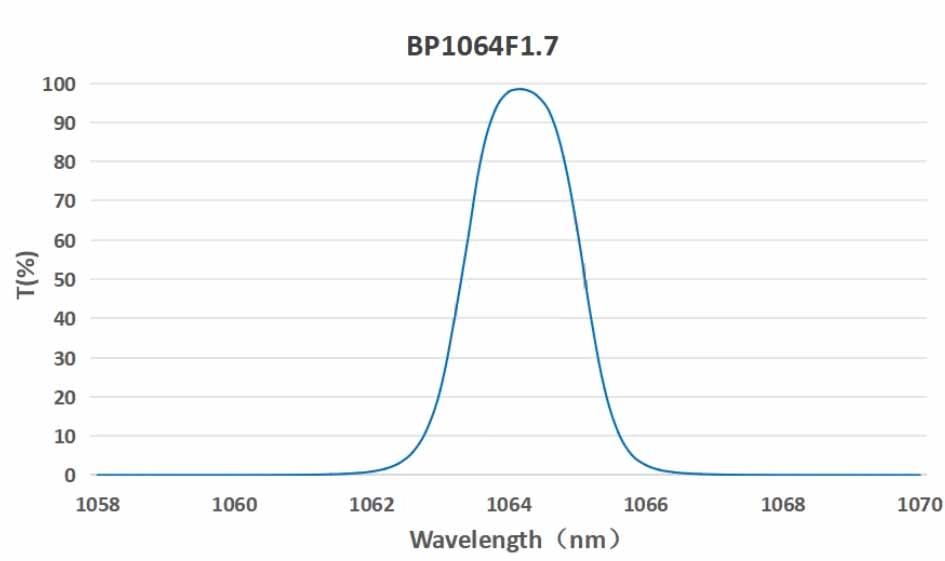
Battery-powered or portable LiDAR devices watch power use closely. An 80% pass filter forces the laser to push harder. It drains more energy for equal spot range. Solid 1064nm bandpass filters hit T>95% at center light. Low-waste dielectric stuffs and smart reflection cuts build this clear pass. They lower inside scatter too. As a result, devices run longer on less power.
| Parameter | Standard Grade Filter | High-Precision Filter (BoDian) | Impact on Performance |
| Peak Transmission (T) | 80% – 85% | >95% | Extends detection range by ~15% |
| Bandwidth (FWHM) | 10nm – 20nm | 1nm – 5nm | Dramatically reduces solar noise |
| Center Wavelength Accuracy | ±2nm | ±0.2nm | Ensures alignment with laser line |
Blocking Depth (OD5/OD6): Maximizing Signal-to-Noise Ratio
Pass rates show what enters. Block levels, or Optical Density (OD), show what gets kept out. For distance tools in bright sun, basic blocks fall short. Deep cuts need OD5 or OD6 levels. These mean 0.001% to 0.0001% pass across sensor ranges. Even with sun straight ahead, sensors catch just the 1064nm light. Strong blocks thus lift signal clarity in tough light.
Laser Induced Damage Threshold (LIDT)
Strong lasers can damage basic coatings fast. Older soft types, like those from zinc sulfide and cryolite, take in water easily. They break down under high energy loads. In 1064nm laser work, Ion-Assisted Deposition (IAD) builds tough coatings. Ions hit the forming layers. This packs them tight, like solid blocks. Such builds resist water and hold high LIDT well. Durable layers ensure long use in demanding tasks.
| Coating Technology | Structure | Moisture Stability | LIDT Suitability |
| Thermal Evaporation | Porous/Columnar | Poor (shifts with humidity) | Low Power Only |
| Ion-Assisted (IAD) | Dense/Bulk-like | Excellent (Zero shift) | High-Power/Industrial |
| Magnetron Sputtering | Fully Amorphous | Superior Consistency | Scientific/Military |
Leybold Helios 800: Ensuring Batch Consistency
Big runs test keeping filters the same from start to end. For detailed 1064nm bandpass filters, a small 0.1% layer slip moves the center light. It throws off setup tunes. Tight controls help avoid such shifts and maintain quality across lots.
The Leybold Helios 800 magnetron sputtering tool tackles this. Unlike old evaporation methods, it has a load-lock setup and steady power. These keep the build space even. It handles layer stacks with plan-based accuracy. Spectral shapes stay firm over the base and runs. This cuts re-tune time and builds trust in light supplies. Consistent batches support smooth project flows.
Projects with odd sizes or light specs beyond stock lists find help in the customized plan service. It sets the needed width, size, and tough-spot limits for the task. Tailored options fit unique demands well.
Conclusion
Basic parts often miss the strict needs of advanced laser tools. This leads to light loss and build breakdowns. Full 1064nm stock sheets, fit plans, and setup tips stand ready. They help reach top accuracy in light paths. Share project facts or contact the build team for a custom fix on next LiDAR or distance gear. Strong support drives better results.
FAQ
Q: How does temperature affect the performance of 1064nm bandpass filters?
A: Basic heat-built filters move by 0.005%/∘C from water loss and growth. In contrast, IAD-tough filters have tight builds. Shifts drop to 3 pm/∘C. Laser light holds in pass zones amid wild outdoor heats. Stable picks handle changes with ease.
Q: Why is OD6 blocking necessary if my laser is very bright?
A: The laser starts strong, but far-target returns fade quick. Sun noise hits thousands of times harder than those returns. OD6 deep blocks cut this noise low. Sensors then pick true laser hits clean. Deep cuts prove vital for clear reads in bright settings.
Q: Can I use these filters in high-power industrial cutting or welding systems?
A: Yes, if the 1064nm bandpass filters carry high LIDT. Tough oxide stuffs like silica work via strong build steps. They manage heavy energy for factory laser checks. These hold up well in rough industrial spots.